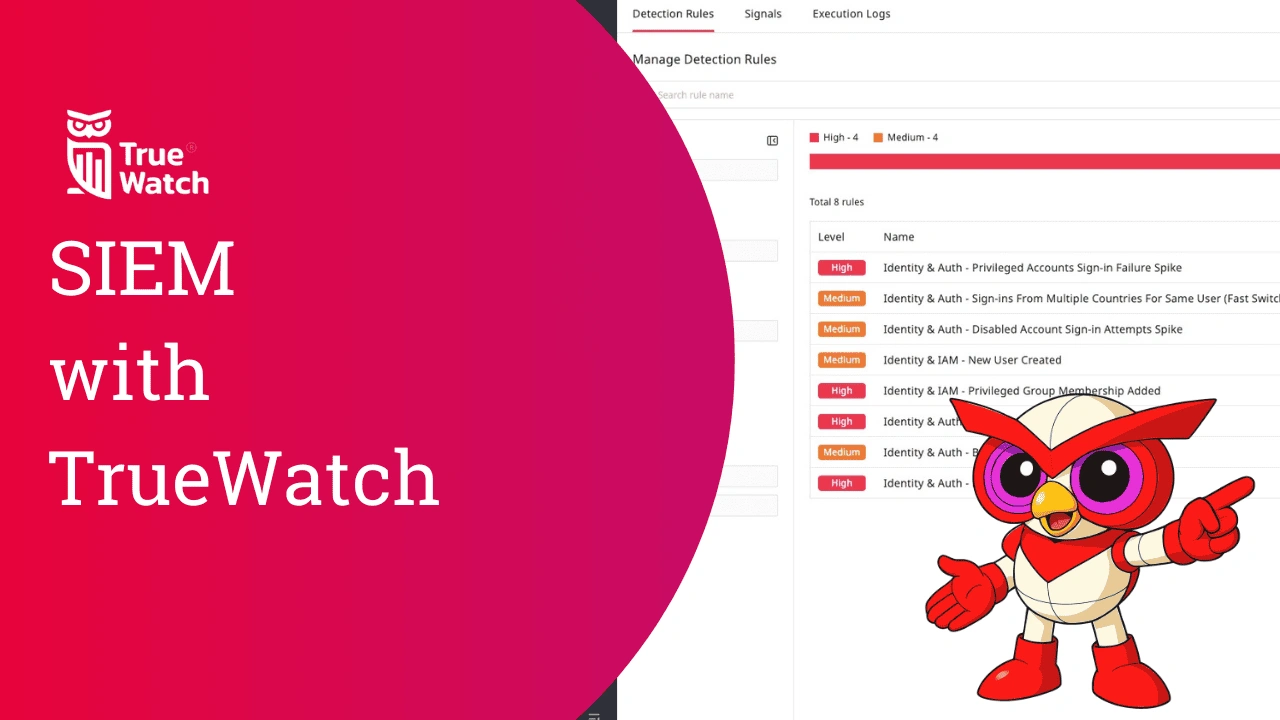
SIEM with TrueWatch
TrueWatch provides powerful SIEM capabilities by leveraging its unified observability platform to collect, correlate, and analyze security logs in real-time. By using TrueWatch’s existing data ingestion engine, teams can identify security threats and meet compliance requirements without needing a separate, disconnected security tool, and reducing operational complexity and response times significantly.
What is SIEM?
SIEM definition
SIEM is a technology solution that provides a comprehensive, real-time view of an organization's entire digital environment by aggregating data from hardware, cloud services, and software applications into one centralized platform. This allows security teams to detect potential threats instantly and maintain a complete historical record of all network activity for better organizational resilience.
Why is SIEM important?
A SIEM serves as the central command center for an organization’s security operations, unifying massive amounts of data into a single interface. By providing this total visibility, it allows security teams to identify and stop sophisticated threats that may have bypassed basic perimeter defenses. Instead of managing dozens of separate tools, analysts can use the SIEM as a centralized hub to monitor their entire digital environment and respond to active risks more effectively.
TrueWatch SIEM integrates these capabilities directly into the TrueWatch console, offering a streamlined experience that makes managing complex security data accessible for teams of all sizes.
How does SIEM work?
Core Functions of a SIEM
The following table breaks down the essential capabilities that allow a SIEM to protect an organization:
| Capability | What it does | Why it matters |
|---|---|---|
| Log Management | Collects, indexes, and enables fast searching of activity logs. | Creates a centralized, searchable record for audits and investigations. |
| Detection (Rules & Analytics) | Uses rules to flag suspicious behavior and generate alerts. | Catches threats and policy violations that manual reviews miss. |
| Correlation | Connects related events across users, IPs, and timeframes. | Helps analysts connect dots quickly to reduce investigation time. |
| Real-Time Alerting | Routes critical notifications to responders via chat or ticketing. | Ensures timely response while reducing noise for the team. |
| Compliance | Produces reports and evidence views aligned to audit needs. | Demonstrates security control effectiveness with traceable proof. |
| Incident Management | Supports workflows to track, assign, and document cases. | Keeps the response coordinated from detection to closure. |
| Threat Hunting | Enables proactive, manual searching for hidden threats. | Finds emerging or stealthy risks that automated rules may miss. |
Now that we understand the mechanics of how a SIEM collects and analyzes data, the next section will explore the specific benefits this technology brings to your organization.
Benefits of SIEM
Implementing a SIEM solution does more than just monitoring a network. SIEM fundamentally changes how a business handles risk. By moving away from fragmented tools and toward a unified system, organizations gain several high-level advantages.
SIEM benefits
The primary value of SIEM lies in its ability to turn massive amounts of raw data into actionable intelligence. Here are the five key benefits:
- Improved Threat Detection: By linking data from multiple sources, SIEM identifies complex attack patterns and subtle "insider threats" that standard antivirus tools often miss.
- Centralized Visibility: It eliminates security blind spots by pulling data from cloud services, servers, and remote devices into a single, unified dashboard.
- Faster Incident Response: SIEM triggers automated response via webhook/notification workflows.
- Automated Compliance: It simplifies meeting regulatory standards by automatically generating the audit trails and reports required by law.
- Stronger Security Posture: Continuous monitoring helps you find vulnerabilities and misconfigurations early, allowing you to fix gaps before they can be exploited.
The TrueWatch Advantage
While a standard SIEM provides these benefits, TrueWatch SIEM takes it further by integrating these insights directly into your existing management console. This means your team doesn't just get alerts. They get a streamlined, high-quality response workflow that reduces alert fatigue and ensures that every notification is meaningful and actionable.
SIEM best practices and use cases
SIEM best practices
Effective SIEM management requires careful planning and ongoing maintenance:
- Define Scope and Goals: Start by identifying your specific business needs and security use cases to ensure the deployment provides the most value.
- Inventory All Data Sources: Create a complete list of all systems that generate logs, including servers, and cloud service.
- Deploy in Phases: Avoid overwhelming your team by starting with critical systems first, then refining your rules before expanding to the rest of the organization.
- Establish Clear Roles: Define specific responsibilities for monitoring alerts, managing logs, and responding to incidents to ensure accountability.
- Plan for Compliance: Map your regulatory requirements to your SIEM settings to automate the necessary auditing and reporting.
- Regularly Tune the System: Continuously adjust your correlation rules to reduce false positives and ensure alerts remain accurate.
- Prepare Response Plans: Document and practice incident response workflows so your team can act immediately when a threat is detected.
SIEM use cases
A SIEM is designed to address specific security challenges that are difficult to manage manually:
- Insider Threats: It uses rules and analytics to identify suspicious activity from legitimate users, which is often missed by tools focused only on external risks.
- Malware and Ransomware: By analyzing endpoint, network, and cloud logs (where available), a SIEM can surface indicators of external attacks early in their lifecycle.
- Advanced Persistent Threats: By correlating data across multiple sources over time, it can detect the subtle, long-term patterns used by sophisticated attackers.
Frequently asked questions (FAQs)
Q: Do I need to buy a separate product to get SIEM features in TrueWatch?
A: No, TrueWatch provides SIEM capabilities as part of its unified observability platform. You can use your existing log data and infrastructure metrics to build security dashboards and detection rules without managing a second vendor.
Q: How does TrueWatch help me spot a security breach?
A: TrueWatch allows you to set up "correlation rules" that look for specific patterns, such as multiple failed login attempts followed by a large data export. If these events happen in a short window, TrueWatch triggers a high-priority alert so you can investigate immediately.
Q: Can I use TrueWatch to meet audit requirements like SOC2?
A: Yes. Because TrueWatch collects and stores immutable logs from across your entire infrastructure, you can easily generate the activity reports and access logs that auditors require to prove your systems are secure and compliant.
Q: Does TrueWatch support security logs from cloud providers like AWS or Azure?
A: Absolutely. TrueWatch has native integrations for major cloud logs, including AWS CloudWatch and Azure Activity Logs. This gives you a single place to monitor for security threats even if your applications are spread across different cloud vendors.
Q: Is it difficult to set up security alerts in TrueWatch?
A: It is quite straightforward because TrueWatch uses the same dashboard and alerting engine you already use for performance monitoring. You simply apply security-focused filters to your logs, like "unauthorized access" or "firewall block", to start receiving security notifications.
Get SIEM with TrueWatch today
Why choose TrueWatch?
TrueWatch stands out by integrating powerful security capabilities directly into a unified observability platform designed for modern, multi-cloud environments. Rather than managing a fragmented array of disconnected tools, your team gains a "mission-control" experience that brings logs, metrics, traces, and security insights together in a single platform.
Stop struggling with fragmented security data. Gain end-to-end visibility and simplify your response with our unified console. Reach out to our experts to get started today!
