

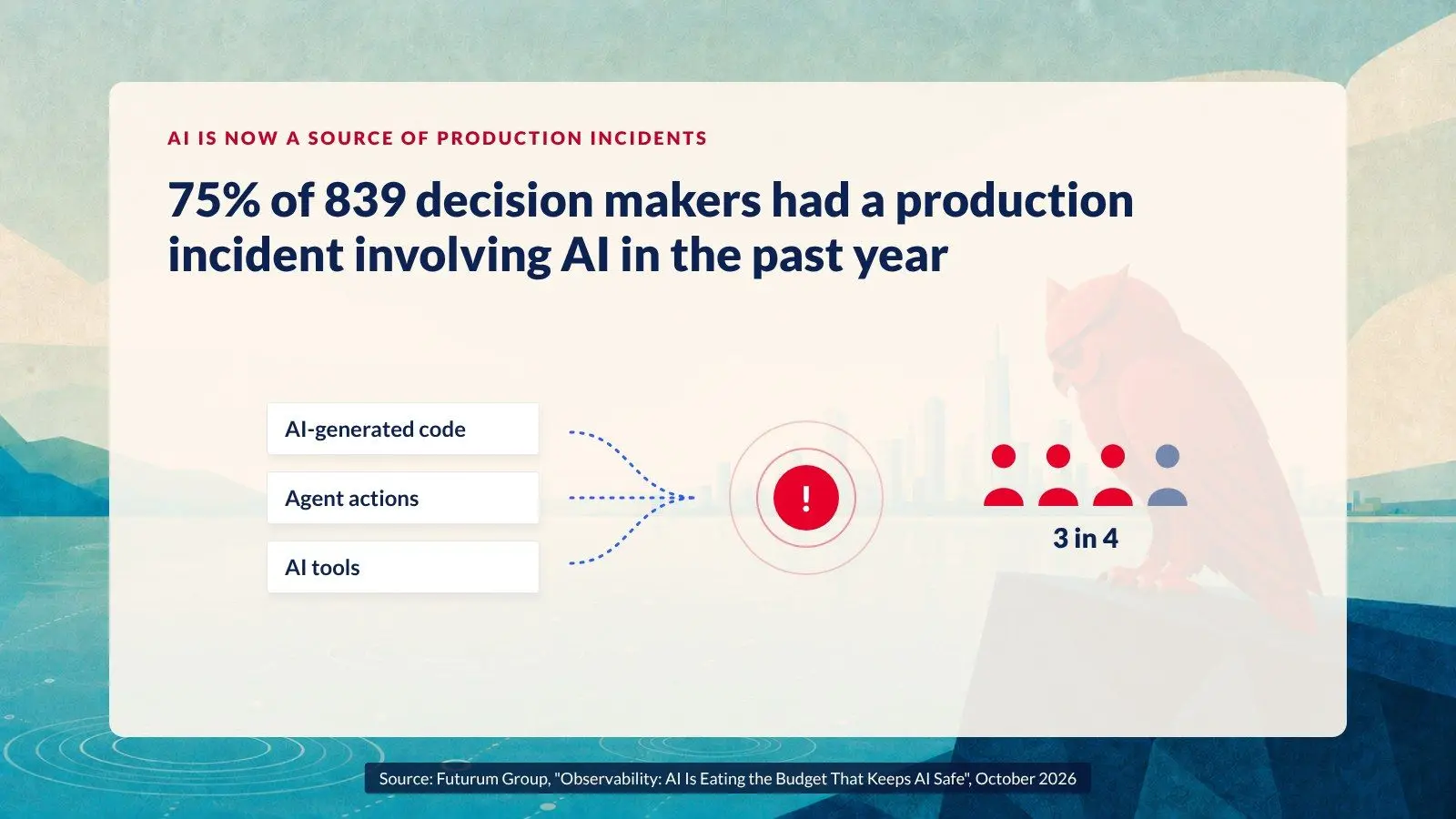
AI SRE is getting serious attention for a simple reason: AI is now one of the things that breaks production. In Futurum Group's October 2026 analysis of observability spending, 75% of 839 decision makers reported at least one production incident in the past year involving AI-generated code, agent actions, or AI tools.
The same research shows the money that pays for watching production is being pulled toward AI cost overruns. More incidents, with new failure modes, investigated by the same on-call engineers using tools that are not growing at the same pace.
This post looks at what the data says, why it changes the case for AI incident response, and what a governed AI SRE should actually do.
AI is now a source of production incidents
For most of the last decade, AI showed up in operations as a helper: anomaly detection, alert grouping, a chat window over the docs. Futurum's figure turns that around. When three in four decision makers can point to a production incident involving AI-generated code, agent actions, or AI tools, AI is part of the incident list, not just the response team.
Part of the reason is volume. Agents and coding assistants produce more changes, and most of those changes look reasonable. An empirical study of 567 agent-assisted pull requests on GitHub found that 83.8% were eventually merged by maintainers, yet only 54.9% of the merged ones went in without further modification. The rest needed human revision, especially for bug fixes, documentation, and project-specific standards.
That is not a case against AI-assisted development. It is a reminder that plausible changes still need checking, and the ones that slip through tend to surface later as alerts. The DORA 2025 State of AI-assisted Software Development research frames AI's role as an amplifier that magnifies an organization's existing strengths and weaknesses. If incident investigation was already slow and manual, AI will amplify that too.
The budget that watches production is helping pay for AI
You might expect observability budgets to grow alongside AI adoption. Futurum's data points the other way.
- AI spend is running hot. 52% of 1,684 respondents said AI spending was above plan over the past six months (Futurum Group).
- Some of it comes from monitoring. Among the 109 organizations that took money from other software budgets, 44% took it from IT operations and monitoring tools.
- Observability spending is rising, slowly. 64% plan to raise observability spending in the next 12 months, but only 19% plan an increase of more than 15%, the lowest share among the five core software lifecycle areas Futurum tracks.
The squeeze is not limited to observability. McKinsey's analysis of agentic AI and tech infrastructure projects a two- to threefold increase in IT infrastructure costs by 2030, with infrastructure budgets expected to remain relatively flat.
Put those together and the operating picture is clear. Production is getting busier and stranger. The tooling and headcount watching it are not scaling at the same rate. Something has to give, and it is usually the on-call engineer's time.
Why more incidents should not mean more on-call hours
Google's SRE book defines toil as work that tends to be manual, repetitive, automatable, tactical, and devoid of enduring value, and that scales linearly as a service grows. Google's SRE organization has an advertised goal of keeping toil below 50% of each SRE's time.
Much of the first hour of an incident fits that description. Open the dashboard. Pull the logs for the affected service. Line up the deploy timeline. Check whether the error rate moved before or after the last change. Write it up for the channel. None of it is hard. All of it is slow, and it is the same every time.
That is the work an AI SRE is well placed to take on. McKinsey's experience suggests agentic AI can enable automation of 60 to 80 percent of routine infrastructure work over time. The same article notes that in any given business function, no more than 10 percent of respondents say their organizations are scaling AI agents. The opportunity is real. Most teams have not captured it yet.
Investigation is the right first job to delegate
Investigation is read-heavy and decision-light. An agent can query metrics, logs, and traces, compare against a baseline, and draft a finding without touching the system. The risky part, changing production, can stay with a person. That split is what makes delegation safe enough to start now.
What an AI SRE agent should and should not do
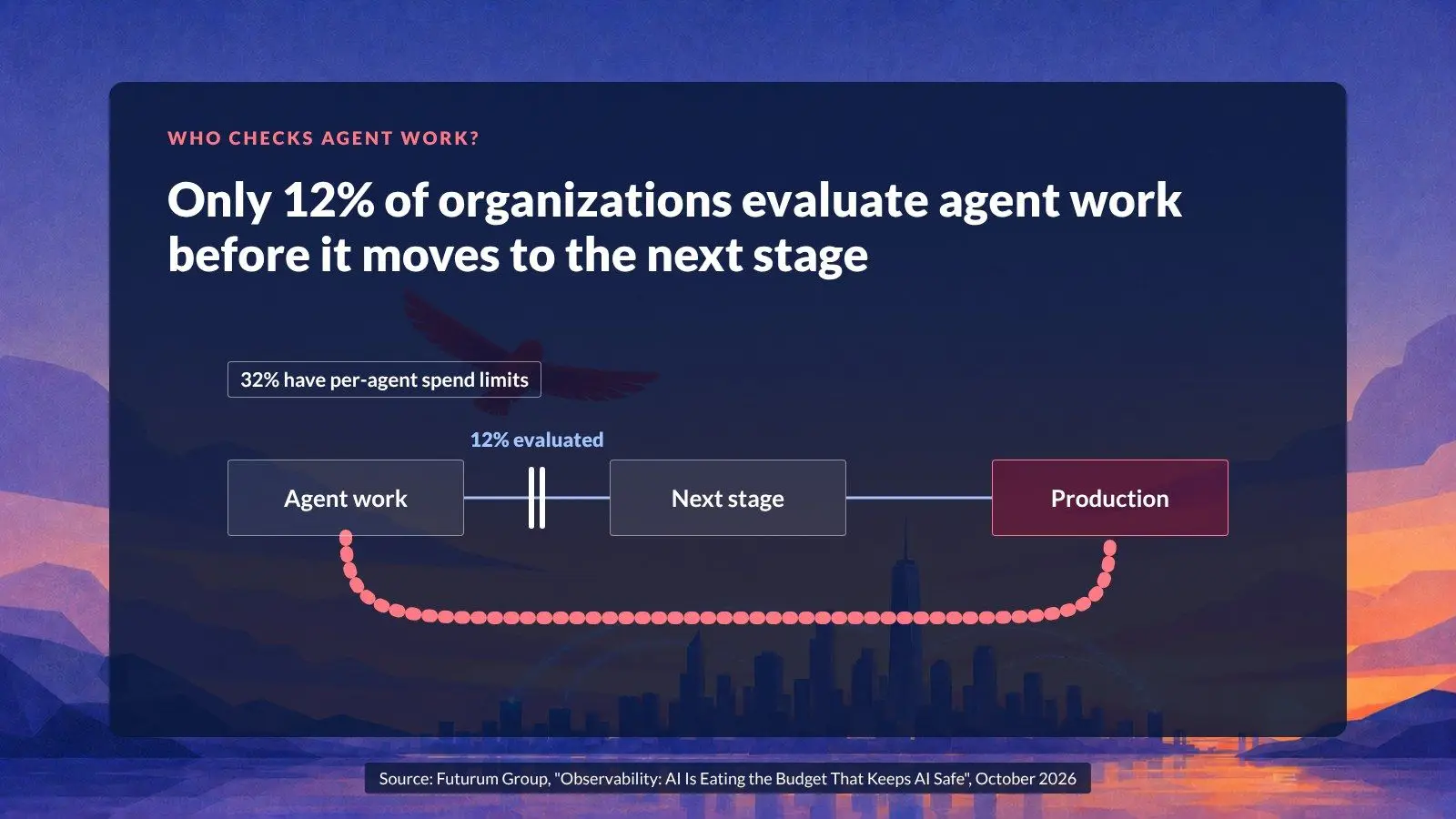
Futurum's research flags how thin agent controls still are. Spending limits per agent or session are in place in 32% of organizations, and only 12% evaluate agent work before it is promoted to the next stage. An AI SRE that adds more unreviewed changes would make the original problem worse.
The NIST AI Risk Management Framework is a voluntary framework for managing risks that AI poses to individuals, organizations, and society. You do not need to adopt it formally to borrow its spirit for an agentic SRE: know what the agent can see, know what it can change, and keep a record you can check.
Scope before speed
An agent should work inside a defined scope: the services, data, and tools you assign. Broad, unscoped access turns a helpful investigator into another source of risk.
Approval before change
Investigation can be autonomous. Changes to a running system should not be. A rollback or a scaling change should arrive as a proposal with evidence, and wait for a human to approve it.
Evidence you can read
Every run should leave a trail: which tools the agent called, what they returned, and the evidence behind its conclusion. That record is what lets an engineer trust a finding in minutes, and what lets a team review agent work after the fact.
How Toby AI Agents handles AI-era incidents
Toby AI Agents are AI teammates you delegate engineering work to. They investigate issues, run checks, return findings, and propose fixes, working in your environment with your tools and approval rules.
- Ready for the role. Each agent comes ready for its role, including SRE, Security, AppDev, FinOps, and Custom. You set the scope once and the agent works inside it.
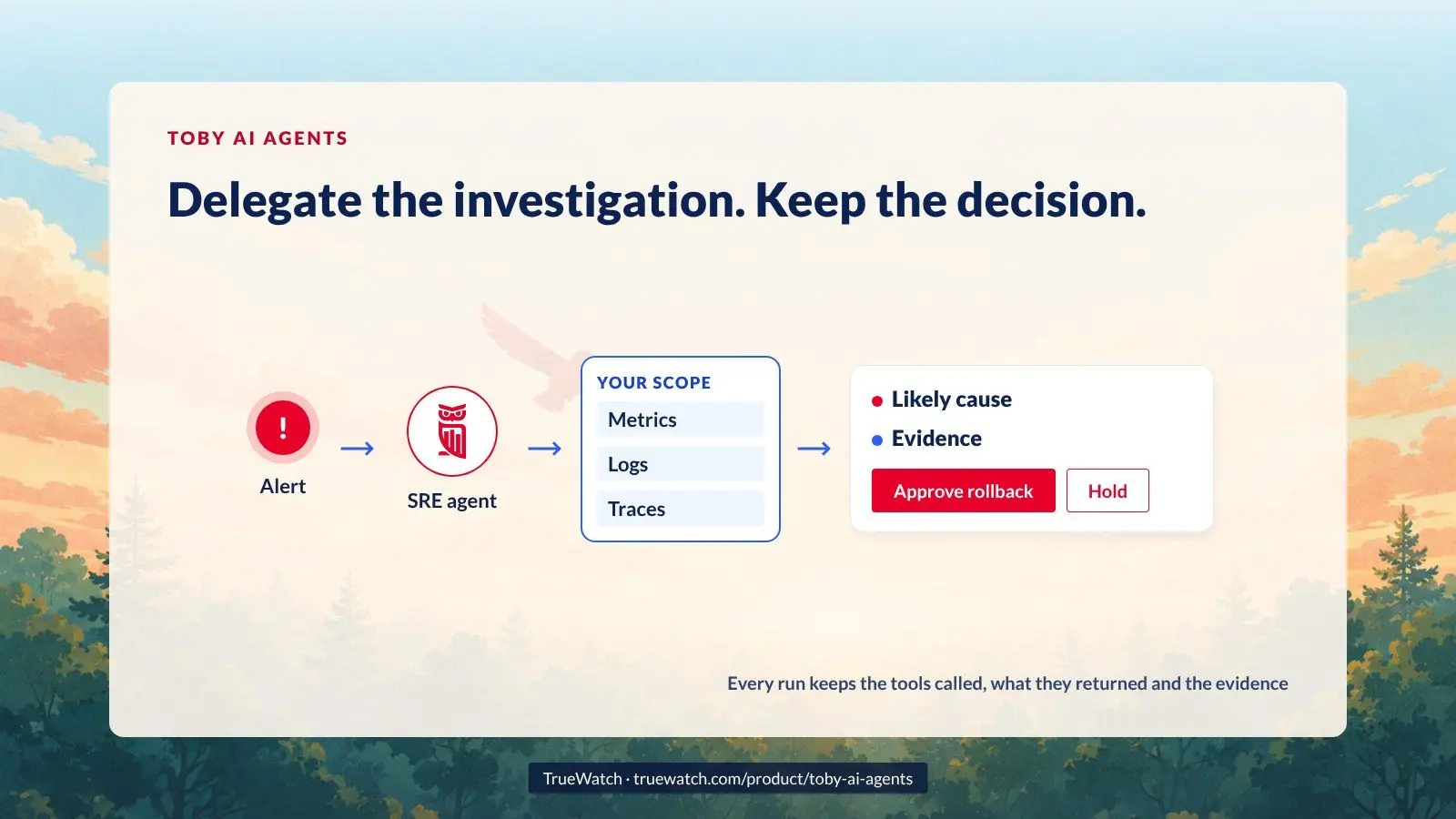
- Incident investigation by an SRE agent. The SRE agent picks up your alert, traces the cause, and leaves a rollback for you to approve. It reads metrics, logs, and traces for the services you scope, and delivers a likely cause, supporting evidence, and a rollback or scaling change for your approval.
- Nothing runs until you approve it. Anything that changes a system waits for a human.
- Every step on the record. Each run keeps the tools the agent called, what they returned, and the evidence behind the answer.
- Where the work already is. Start an agent from a dashboard, an alert, a DQL query, or Slack and mobile. Agents run on alerts, on schedules, or when you ask a question.
- Recurring checks on a schedule. Schedule runs hourly, daily, on weekdays, weekly, or with cron, with results posted to team chat. Changes still wait for approval.
- Runs on infrastructure you control. Install the agent runtime on a Linux host or in a container you manage, and keep control of the network and permissions.
For a closer look at how approvals and evidence work together, read Human in the Loop AI Agents: Fixing the Review Bottleneck and AI in IT Operations: Agents Investigate, Humans Decide.
FAQ
What is an AI SRE? An AI SRE is an AI agent that takes on site reliability work such as alert triage, log investigation, and trace analysis. A well-governed one investigates on its own but proposes changes for a human to approve, and keeps a record of how it reached its answer.
How is AI incident response different from traditional incident response? The steps are familiar: detect, investigate, mitigate, review. The difference is who does the first pass. An AI SRE agent can gather the evidence and draft a likely cause while the on-call engineer is still opening the alert, so the human starts from a finding instead of a blank page.
Will an AI SRE agent make production changes on its own? With Toby AI Agents, no. Anything that changes a system, such as a rollback or a scaling change, waits for your approval.
What data can Toby AI Agents see? Only what you scope. The SRE agent reads metrics, logs, and traces for the services you assign. Dashboards and every agent read from the same place through one data engine and one DQL, with no copy of the data.
Why does AI-generated code make incident investigation harder? AI-generated changes often look reasonable and can pass a quick review. Futurum found that only 12% of organizations evaluate agent work before it is promoted to the next stage. When agent work is not checked early, problems tend to surface later in production, where someone has to work out what changed and why.
Give every incident an investigator
AI is adding to the incident list while the budget for watching production stays tight. You do not need more people staring at more dashboards. You need investigations that start the moment an alert fires, return evidence you can check, and leave every change for a human to approve.
Meet Toby AI Agents and delegate the investigation, not the decision.
