
Datadog alternatives are observability platforms that cover the same ground as Datadog, such as metrics, logs, traces, APM and real user monitoring, with a different pricing model, deployment option or data residency setup. The seven Datadog competitors in this guide are TrueWatch, Grafana Cloud, New Relic, Dynatrace, SigNoz, groundcover and Better Stack. If you want full-stack and AI observability in one platform, published usage-based pricing and data kept in the region you choose, start with TrueWatch.
Datadog is one of the most complete observability platforms available. Teams usually start looking for an alternative for one of three reasons: the bill grows faster than the infrastructure, they need data stored in a specific region, or they want AI and LLM workloads observed in the same place as everything else.
Why teams look for Datadog alternatives
The bill has many moving parts
Datadog prices each product on its own unit: hosts, APM hosts, GB of logs ingested, indexed log events, RUM sessions and more. Each unit is reasonable on its own. Together, they make the monthly total hard to predict, which is why "how to reduce Datadog costs" is a common search among existing customers.
Data residency requirements
Regulated industries and public sector teams often need telemetry stored in a specific country or region. Before you migrate, check which regions a platform offers and whether a private deployment is available.
AI workloads need their own telemetry
Applications that call LLMs or run AI agents produce new signals: prompts, sessions, token usage, cost per call and output quality. Teams increasingly want these traced next to the services, databases and infrastructure they depend on, rather than in a separate tool.
How we compared these Datadog competitors
- Pricing model: per host, per GB, per event, or consumption based.
- Open ingestion: native OpenTelemetry support versus a proprietary agent only.
- AI observability: whether LLM calls and agent runs can be traced.
- Data residency: which regions you can choose.
Datadog alternatives at a glance
| Platform | Pricing model | Best for |
|---|---|---|
| TrueWatch | Usage based, billed daily by data volume | Teams that want full-stack and AI observability in one platform, with regional data residency |
| Grafana Cloud | Free tier, then usage based per product | Teams already running Prometheus, Loki or Grafana dashboards |
| New Relic | Data ingested plus user seats | Teams that want one subscription across all products |
| Dynatrace | Annual consumption commitment | Large enterprises that want heavy automation |
| SigNoz | Open source, or usage-based cloud | OpenTelemetry-first teams comfortable with open source |
| groundcover | Per host, not per data volume | Kubernetes teams that want a predictable bill |
| Better Stack | Tiered plans | Smaller teams focused on uptime, logs and incident response |
1. TrueWatch: full-stack and AI observability in one platform
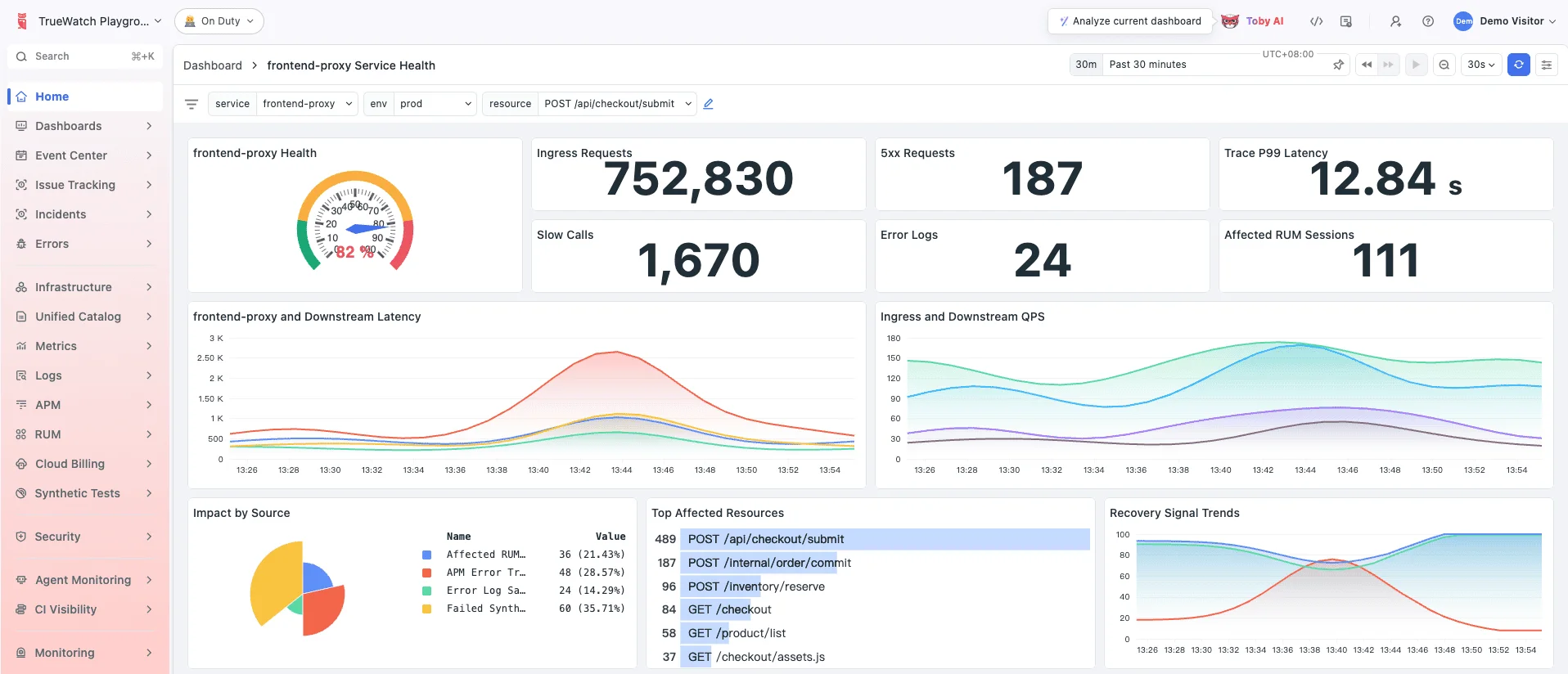
TrueWatch is an observability platform built for the AI era. Metrics, logs, traces, real user monitoring, synthetic tests and AI agent and LLM telemetry sit in one data foundation, collected through OpenTelemetry, DataKit and open APIs. It is the option in this list that addresses all three reasons teams leave Datadog in a single platform: pricing, data residency and AI observability.
Pricing you can read before you sign up
TrueWatch pricing is usage based and billed daily by the volume of data you actually report. Every rate is published per product, so you can estimate a bill from your own line items before talking to sales. New accounts start with free credits, which makes it practical to run a real workload before committing.
Data residency in the region you choose
TrueWatch runs regional SaaS sites in Singapore, Jakarta, Frankfurt, Oregon and Johannesburg. If your data cannot leave your own environment, private SaaS runs inside your own VPC. For teams in Southeast Asia, this means telemetry can stay in-region without operating the platform yourself.
AI observability and Toby AI built in
TrueWatch AI Agent Observability traces LLM calls, sessions, token cost and output quality alongside the APM, Infrastructure Monitoring and Log Management data from the same services. When something breaks, you see the model call and the database query in the same view.
Two Toby AI products work on top of that data:
- Toby AI TruePilot answers questions about your systems in natural language, so engineers can query telemetry without writing a query.
- Toby AI Agents run investigations within the permissions you configure, covering root cause localization, task orchestration and remediation steps.
Open data collection, no lock-in
TrueWatch accepts OpenTelemetry data natively, alongside its own DataKit collector and open APIs. If your services are already instrumented with OpenTelemetry, you can point the exporter at TrueWatch without re-instrumenting. TrueWatch also documents DDTrace integrations, which can shorten a move for services that use Datadog tracing libraries today.
Security and procurement
TrueWatch holds SOC 2 Type II and ISO/IEC 27001 certifications and is available on Google Cloud Marketplace. Customers include Anta, ComfortDelGro, DStv and Standard Bank.
- Where it fits: you want metrics, logs, traces, RUM and AI observability in one platform; you need data kept in-region; or you want a bill you can calculate from published rates.
- Things to check: confirm the regional site that matches your compliance needs, and request Toby AI Agents access early if autonomous investigation is part of your evaluation.
2. Grafana Cloud
Grafana Cloud is the managed version of the Grafana, Prometheus, Loki and Tempo stack. It offers a free tier and usage-based pricing per product.
- Where it fits: your team already builds on open-source Grafana tooling.
- Things to check: pricing is set per product, so estimate metrics, logs and traces separately.
3. New Relic
New Relic sells one platform subscription instead of per-product SKUs. Its free tier includes 100 GB of ingest per month.
- Where it fits: you want a single contract and a free tier to start.
- Things to check: user seats are part of the bill, so count how many people need full access.
4. Dynatrace
Dynatrace uses an annual consumption commitment across the whole platform and focuses on automated discovery and root cause analysis. It offers a 15-day free trial.
- Where it fits: you are a large enterprise with a complex estate and budget for a platform commitment.
- Things to check: the annual commitment means planning usage up front.
5. SigNoz
SigNoz is an open-source, OpenTelemetry-native platform for metrics, traces and logs, available self-hosted or as a cloud service.
- Where it fits: you want an open source Datadog alternative and can operate it yourself.
- Things to check: self-hosting means your team runs storage, upgrades and scaling.
6. groundcover
groundcover prices per host rather than by data volume and uses eBPF to collect data from Kubernetes with little instrumentation.
- Where it fits: your spend is driven by data volume and your workloads run on Kubernetes.
- Things to check: confirm coverage for any workloads that run outside Kubernetes.
7. Better Stack
Better Stack combines uptime monitoring, logs and incident management with a simple interface.
- Where it fits: you are a smaller team and uptime plus logs cover most of what you need.
- Things to check: confirm it covers the APM, RUM or AI observability signals you rely on today.
How to choose a Datadog alternative
- List your current Datadog line items: hosts, APM hosts, GB of logs ingested, indexed log events and RUM sessions.
- Match each line to the alternative's billing unit. Per-host and per-volume models reward different workloads.
- Check where the data would be stored and whether that meets your compliance needs.
- Decide whether AI and LLM workloads need to be observed in the same platform.
- Instrument with OpenTelemetry where you can, so the same data can flow to any shortlisted tool.
- Run the same workload on two shortlisted tools for two weeks before deciding.
Frequently asked questions
What are the main Datadog alternatives?
The Datadog alternatives covered here are TrueWatch, Grafana Cloud, New Relic, Dynatrace, SigNoz, groundcover and Better Stack. They differ mainly in pricing model, OpenTelemetry support, AI observability and where data is stored.
Is there a cheaper alternative to Datadog?
It depends on what drives your bill. If hosts drive it, a usage-based tool such as TrueWatch can cost less. If data volume drives it, a per-host tool can. Compare your own line items against published rates, not list prices alone.
How can I reduce Datadog costs?
Start by listing which line items grow fastest, such as logs ingested or indexed events. Then compare those units with a usage-based platform that publishes its rates, and test the same workload before switching.
Is there an open source Datadog alternative?
Yes. SigNoz is open source and OpenTelemetry native, and Grafana Cloud is built on the open-source Grafana, Prometheus, Loki and Tempo stack. TrueWatch is not open source, but it accepts OpenTelemetry data natively, so your instrumentation stays portable.
Which Datadog alternatives support OpenTelemetry?
TrueWatch, Grafana Cloud, New Relic, Dynatrace and SigNoz all accept OpenTelemetry data.
Which Datadog alternatives support LLM tracing?
TrueWatch traces LLM calls, sessions, token cost and output quality in the same platform as its APM, logs and infrastructure data.
Which alternatives have data centres in Southeast Asia?
TrueWatch runs regional sites in Singapore and Jakarta. Datadog's Asia-Pacific sites are in Japan (AP1) and Australia (AP2).
Try TrueWatch as your Datadog alternative
Bring one service, one log source and one AI workload. New TrueWatch accounts start with free credits, so you can see your own data, your own bill and Toby AI in action before you decide.
