Observability in the Agentic AI era
The next shift is not better dashboards. It is faster, governed action built on reliable operational context.
TrueWatch is leading the transition into agentic AI observability by moving beyond static dashboards toward autonomous, governed action grounded in operational context. By linking real-time telemetry with service ownership and automated runbooks, TrueWatch enables teams to bridge the gap between seeing a problem and resolving it, reducing manual handoffs and accelerating the path from signal to response.
What agentic AI changes
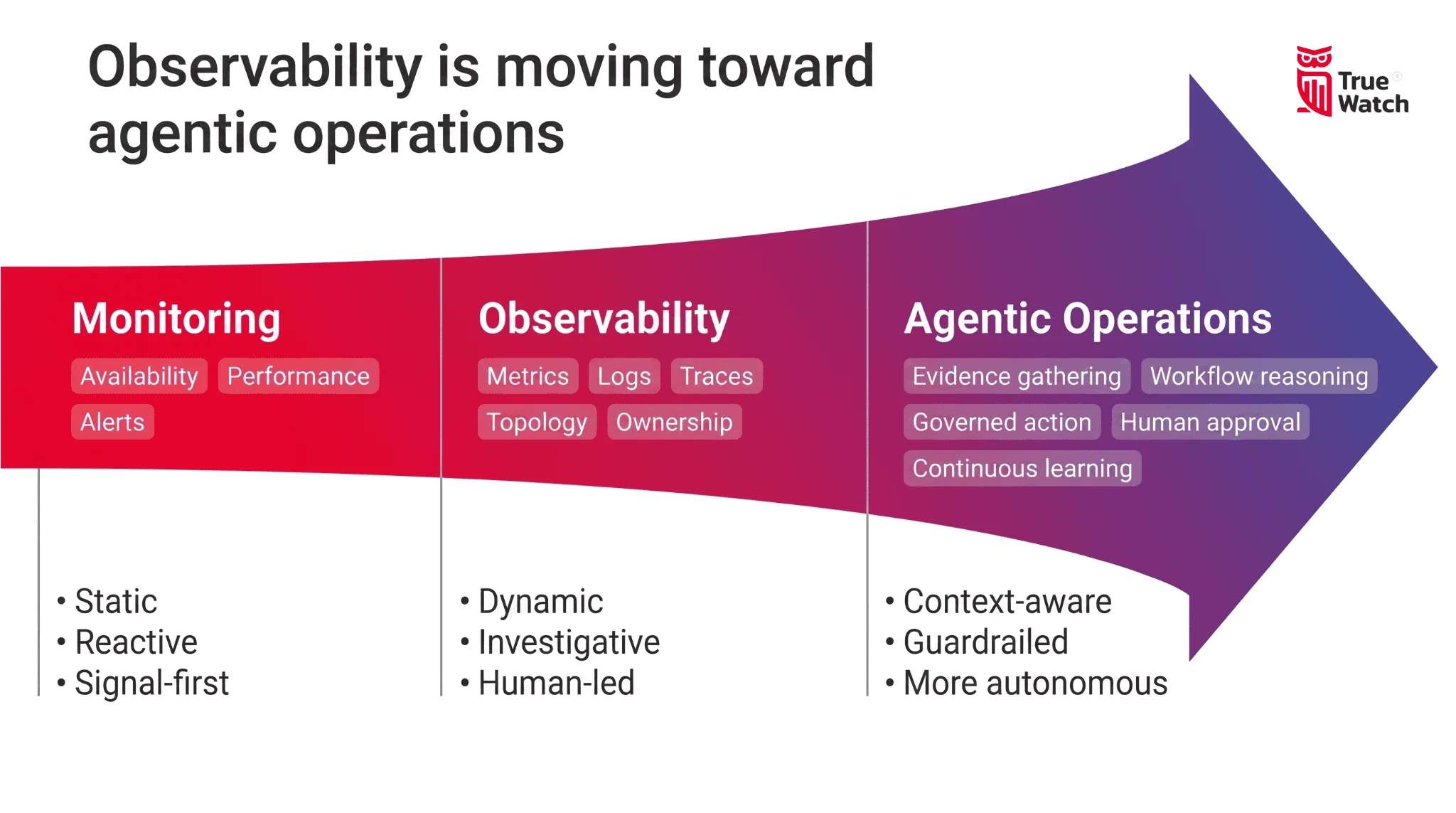
Agentic AI is often described as software that can reason, plan, and act with more autonomy than a traditional assistant. In operations, that means something practical: a workflow can begin with an alert, gather the most relevant evidence, check service ownership, review recent changes, follow a known runbook, and prepare the next step for human review. The goal is not to remove operators. It is to shorten the path between signal and response.
This is an important distinction. Adding a chatbot on top of telemetry is not the same as building a system that can investigate across tools and support action within guardrails. The value of agentic AI in operations is not conversation alone. It is structured reasoning grounded in real operational context.
Dashboards do not disappear. Teams still need them for drill-down, validation, and shared visibility. But dashboards no longer need to carry the full weight of the investigation. More value moves into workflow design, evidence capture, approval paths, and policy. The question starts to shift from “What does this chart show?” to “What did the workflow check, what did it find, and what should happen next?”
Why observability matters more, not less
Some people hear AI and assume observability becomes less important. In practice, the opposite is true. AI is only useful in operations when it can work from reliable evidence. A spike in latency does not explain itself. An error burst does not tell you whether the likely cause is a bad deployment, a slow dependency, a capacity issue, or an upstream change. That meaning comes from context layered around the signal.
This is where observability evolves. It is no longer only a system for storing and querying telemetry. It becomes part of the evidence layer for investigation and governed action. When signals are linked to service ownership, topology, recent changes, runbooks, and business impact, teams can move from raw data to grounded decisions much faster.
What becomes more important now
As this shift happens, some operational assets become much more valuable.
- Runbooks become executable guidance, not static documents.
- Ownership maps become essential for routing and accountability.
- Service relationships matter more because incidents rarely stay isolated.
- Approval rules define where automation can safely help and where humans must stay in control. In other words, the operating model around observability starts to matter as much as observability data itself.
What teams should do now
The best preparation for this shift does not start with prompts. It starts with operational hygiene.
Teams should make service ownership clear. Clean up runbooks so they reflect what actually happens during incidents. Capture change history in a way that is easy to query. Define which actions are safe to recommend, which are safe to prepare, and which always require human approval.
Then start small. Pick one repeated incident pattern, one important service, and one response path that is worth making faster and safer. Begin in read-only mode. Check whether the workflow gathers the right evidence, tells a believable story, and points to a useful next step. That is how trust is built.
Observability is not becoming less relevant in the agentic AI era. It is becoming more foundational. The teams that understand this shift early will be in a much better position to move from reactive investigation toward context-aware, governed action.
Frequently asked questions (FAQs)
Q: Does Agentic AI replace the need for human SREs or Developers?
A: No. Agentic AI is designed to handle the "drudge work" of investigation—like gathering logs and checking deployment history—so that humans can focus on high-level decision-making. TrueWatch ensures that humans remain in control through defined approval paths and guardrails.
Q: How does Agentic AI differ from a standard AI chatbot?
A: A chatbot primarily answers questions based on existing data, whereas Agentic AI can reason through a problem and execute a plan. For example, it can proactively check if a recent code push caused a latency spike and prepare a rollback recommendation before a human even opens the dashboard.
Q: Is my observability data high-quality enough for Agentic AI?
A: AI is only as good as the evidence it has. This is why TrueWatch emphasizes "operational hygiene," such as maintaining updated runbooks and service maps. The more structured your observability data is, the more effectively an AI agent can reason through system failures.
Q: Can I control which actions the AI is allowed to take?
A: Absolutely. TrueWatch allows you to set strict governance policies. You can choose to let the AI handle read-only investigations automatically, while requiring explicit human approval for any corrective actions like restarting services or rolling back deployments.
Q: Why is "context" so important for AI in observability?
A: Without context, a metric is just a number. By linking metrics to service relationships and ownership, TrueWatch allows the AI to understand that a database slowdown is actually being caused by a specific upstream microservice, leading to much faster and more accurate resolutions.
Where observability is heading next
At TrueWatch, this is the shift we are paying closest attention to: moving from visibility alone toward context-aware, governed action.
We believe that is where observability is heading next. Not away from humans, and not away from telemetry, but toward operating models that shorten the path from signal to response without losing trust, control, or accountability.
The teams that prepare for that shift early will be in a much stronger position to turn AI from an interesting interface into a real operational advantage.
