
A leading Singapore ride-hailing company moved its business system monitoring from Datadog to TrueWatch in about two months. The team was looking for a Datadog alternative that could cover more of its systems on the same annual budget, keep telemetry close to its Singapore operations, and work across AWS, Huawei Cloud, and the managed services its engineers already use. This case study explains why the team made the move, how the migration ran, and what changed for its teams.
About the Company
The company is a long-established Singapore transport operator with operations across several international markets. In Singapore, it runs a ride-hailing app used by residents and visitors.
For a business like this, observability supports more than engineering. It underpins the reliability of customer-facing mobility services, day-to-day operations across regions, and expansion into new markets.
Why the Company Looked for a Datadog Alternative
As the company grew, its telemetry volume, infrastructure complexity, and multi-region footprint grew with it. The company had used Datadog for business system monitoring, and over time three constraints became clear.
Cost limited how much the company could monitor
As telemetry volume and monitoring scope grew, so did budget pressure. Under its annual budget, the company could not connect every business system or turn on every capability it needed.
The practical risk was partial visibility. When only part of a system is monitored, blind spots appear in incident response, service reviews, and capacity planning.
Regional coverage added latency and governance questions
At the time of the evaluation, the regional sites available to the company did not fully match its operational needs. Sending monitoring data from Singapore-based systems to a distant region added latency and raised data governance considerations.
For systems that depend on fast detection and response, the location of observability infrastructure matters. The closer telemetry processing sits to the business system, the easier it is to plan for latency, data residency, and operational control.
Multi-cloud support did not cover the full stack
The company runs on AWS, Huawei Cloud, and a range of managed services. AWS integration was well covered, but the company needed the same depth across every cloud platform and service its teams relied on.
In a multi-cloud organization, observability has to follow the real production stack: cloud resources, managed services, databases, middleware, open-source components, applications, and the end-user experience.
How the Company Evaluated TrueWatch
The company was introduced to TrueWatch through its partner FirstWave Tech and began evaluating it as an alternative observability platform.
TrueWatch is a unified observability platform covering infrastructure monitoring, log analysis, distributed tracing, user behavior analysis, alerting, and dashboards. The company's evaluation focused on five practical requirements.
1. A cost model that supports broader coverage
On a similar annual budget, TrueWatch allowed the company to monitor a wider share of its global business systems.
Cost shapes architecture. If teams have to leave systems out or shorten retention to control spend, the monitoring setup is less useful when an incident happens. The company needed a model that let observability grow with the business.
2. DDTrace compatibility for a lower-effort migration
TrueWatch supports key parts of the Datadog ecosystem, including DDTrace. The company's teams did not have to rewrite or re-instrument every application before sending telemetry to the new platform.
On AWS ECS on Fargate, for example, existing services kept their ddtrace agents. The Datadog Agent container was replaced with DataKit, TrueWatch's open-source collector, which receives traces, metrics, StatsD data, and container logs, while a Fluent Bit log router handles log forwarding.
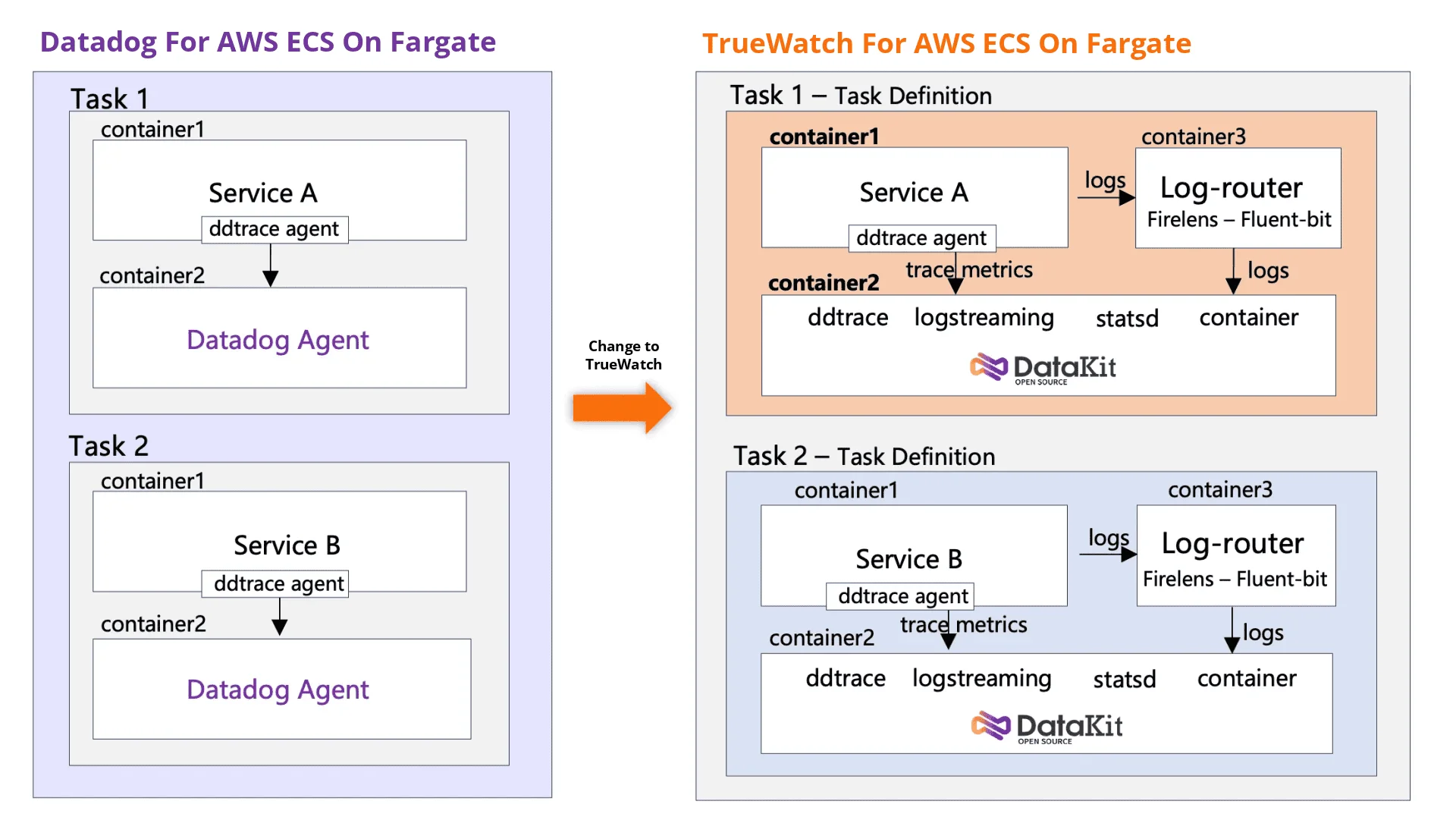
Compatibility lowers both technical risk and resistance to change. Engineers keep their existing instrumentation and move analysis, dashboards, and alerting into TrueWatch step by step.
3. Multi-cloud observability in one platform
The company needed visibility across AWS, Huawei Cloud, MongoDB Atlas, Redis Cloud, and open-source components. TrueWatch's integrations let the company collect and analyze telemetry from all of these in one place.
This addressed a common multi-cloud problem: each cloud or managed service has its own monitoring console, and none of them shows the full service path. TrueWatch gave the company a shared operational view across providers and technologies.
4. A structured migration plan
The company completed the overall migration from Datadog to TrueWatch in about two months. The plan covered assessment, data migration, system integration, validation, and final switchover.
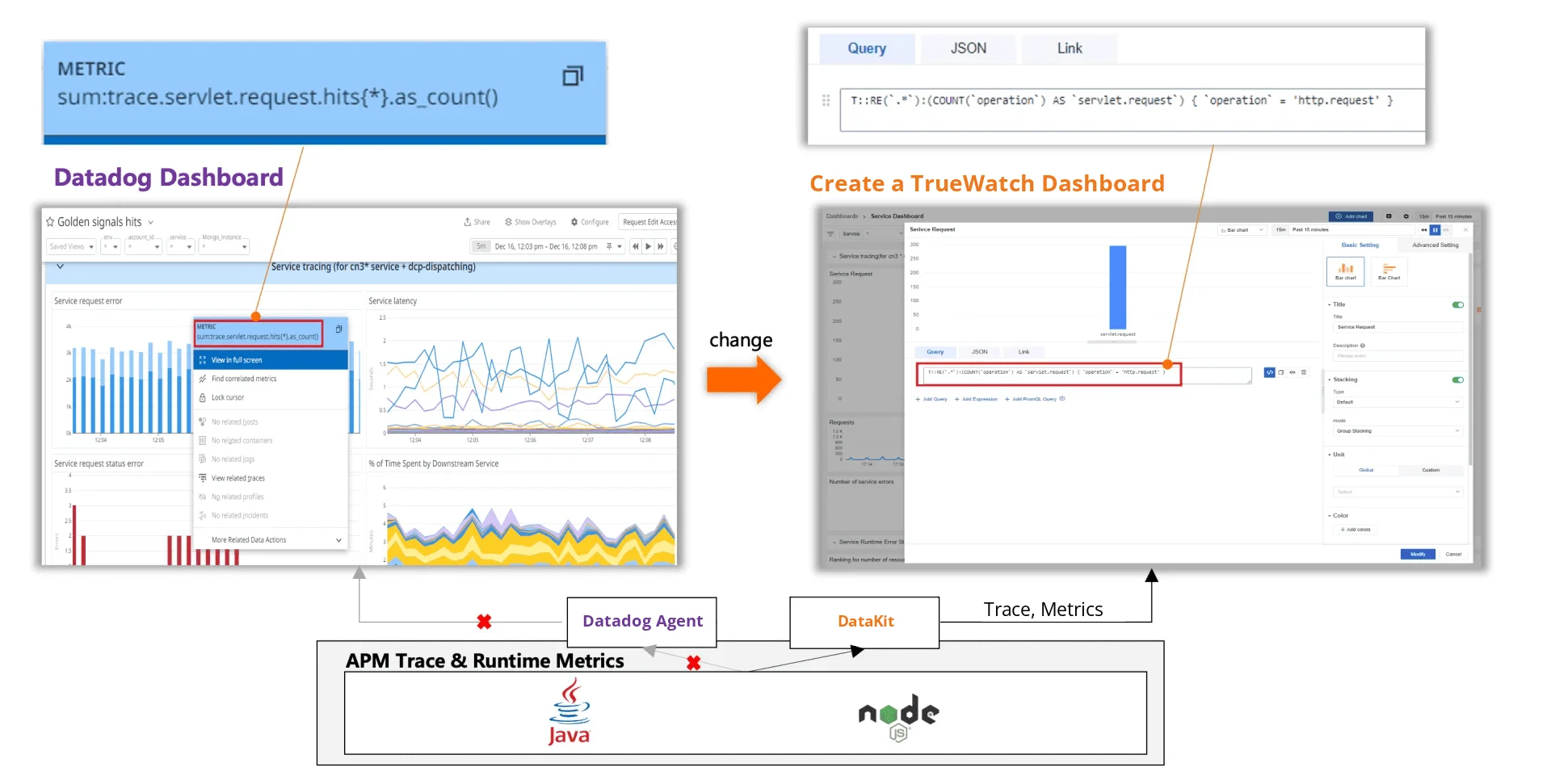
TrueWatch's technical team worked with the company and FirstWave Tech to reduce operational risk, keep monitoring continuous, and help engineering teams adopt the new workflows. Existing dashboards were rebuilt in TrueWatch from the same APM trace and runtime metrics, now collected by DataKit.
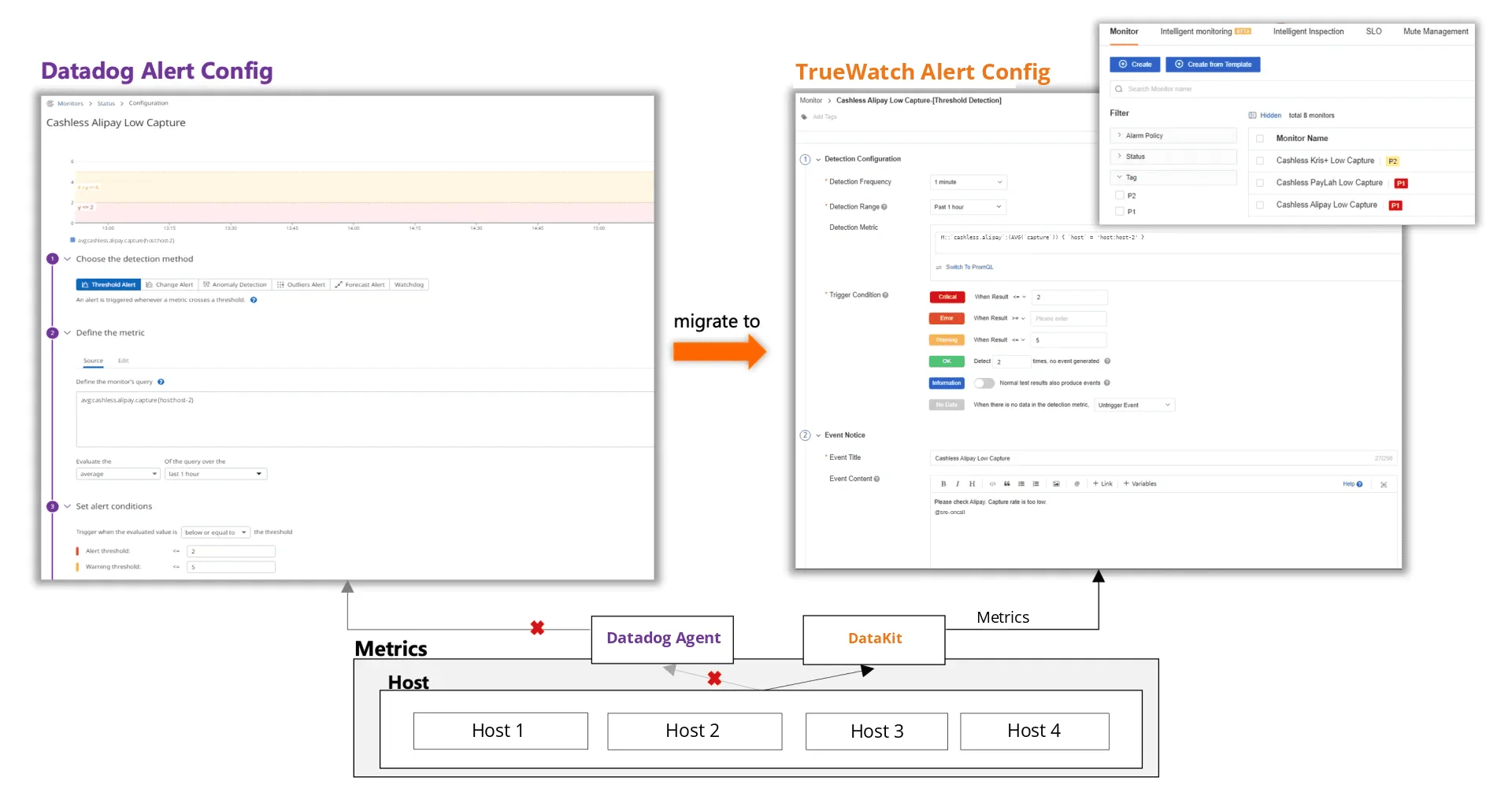
Alert rules followed the same path. Monitors were recreated in TrueWatch with matching thresholds and detection windows, using host metrics collected by DataKit.
5. A Singapore node for local operations
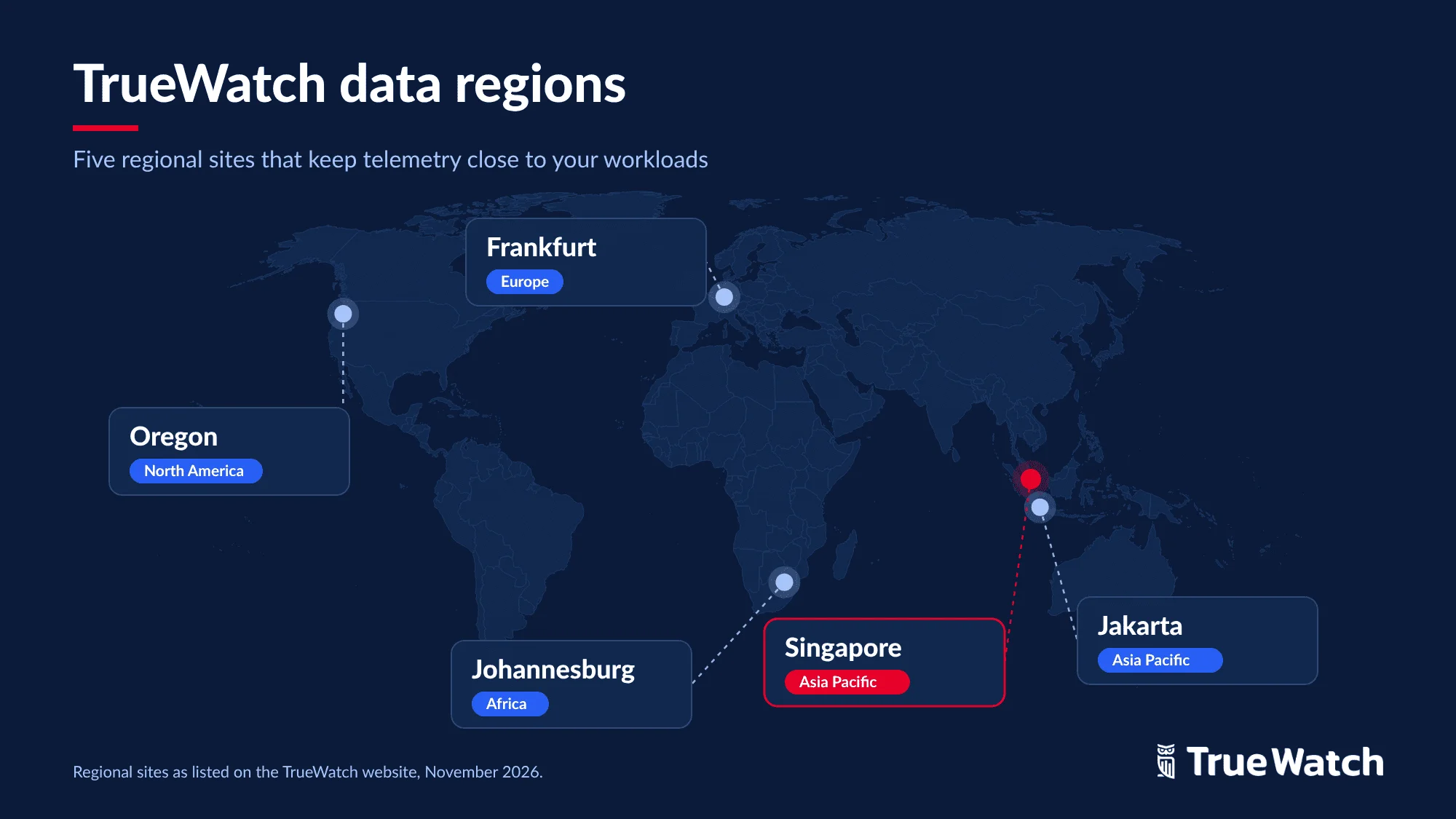
TrueWatch runs regional sites in Singapore, Jakarta, Frankfurt, Oregon, and Johannesburg. For the company, the Singapore site was especially important.
Processing telemetry locally can reduce latency and support regional data governance requirements. For a Singapore-based mobility platform, this shaped how confidently the company could extend observability across its production services.
Results of the Migration
For the company, moving to TrueWatch was more than a tool replacement. It supported an operating model built for global expansion. The migration gave the company:
- Wider observability coverage under a more workable cost structure.
- A migration path that kept existing DDTrace instrumentation in place.
- One view across AWS, Huawei Cloud, MongoDB Atlas, Redis Cloud, open-source systems, and applications.
- Local support through FirstWave Tech and TrueWatch's service network in Southeast Asia.
- A Singapore observability site aligned with its latency and governance needs.
The company's decision came down to its own priorities: coverage within budget, local service, regional deployment, and compatibility with the stack it already runs.
FAQ
How long did the migration from Datadog take?
About two months, covering assessment, data migration, system integration, validation, and final switchover.
Can teams keep DDTrace instrumentation when moving to TrueWatch?
Yes. TrueWatch supports DDTrace, so the company kept its existing ddtrace agents and replaced the Datadog Agent with DataKit to collect traces, metrics, and logs.
Does TrueWatch support multi-cloud observability?
Yes. The company uses TrueWatch to monitor AWS, Huawei Cloud, MongoDB Atlas, Redis Cloud, and open-source components in one platform.
Where can TrueWatch process telemetry data?
TrueWatch runs regional sites in Singapore, Jakarta, Frankfurt, Oregon, and Johannesburg. The company uses the Singapore site to keep telemetry close to its operations.
