
AI agents can already call tools. That part is solved.
Codex, Claude Code, OpenClaw, and most modern agent frameworks can already query logs, pull metrics, and hit an API. TrueWatch supports all of them through CLI, MCP Server, and OpenAPI, so any agent can reach observability data and platform actions in minutes.
The harder question is what happens next: can that agent operate inside production boundaries, follow a real troubleshooting methodology, respect permissions, and leave an evidence trail — every time, not just in the demo? That question is what Toby AI Agents is built to answer — turning agentic observability from a buzzword into an operational discipline.
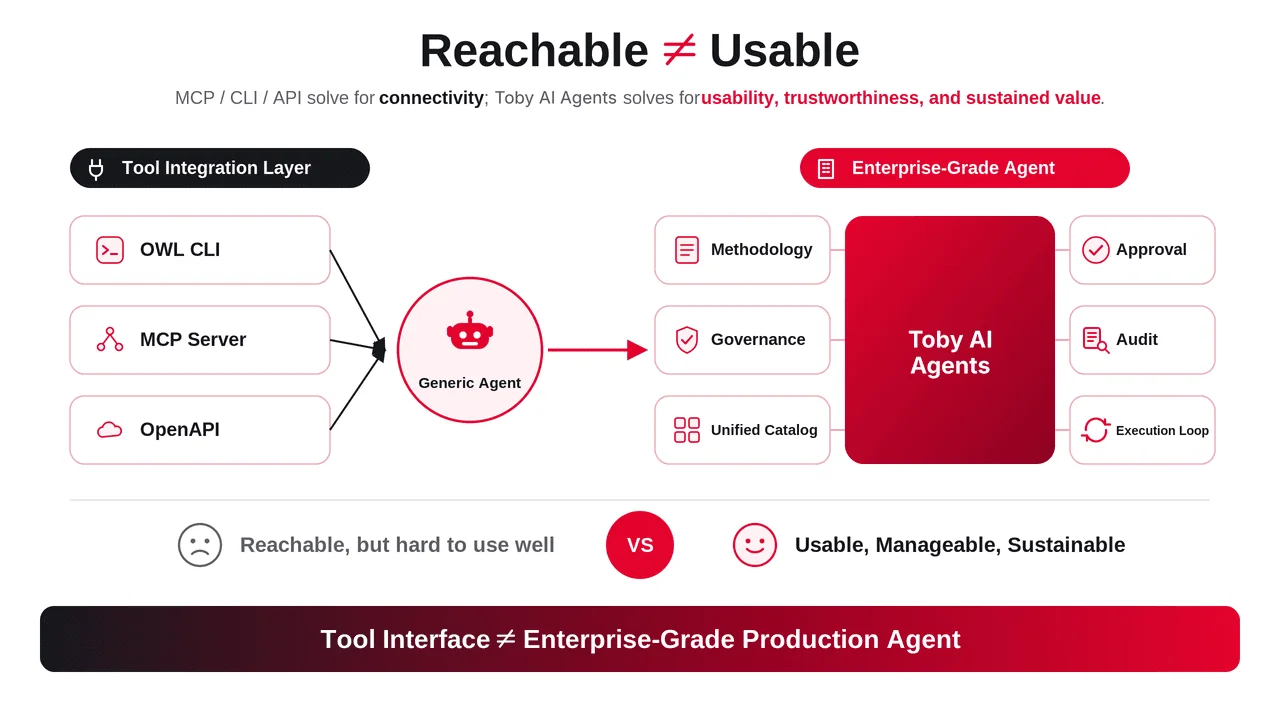
Tool Calling Is Not Incident Methodology
A general-purpose agent with API access can query logs, metrics, and traces. That does not mean it understands how production incidents actually unfold.
When P99 latency spikes, error rates climb, a database connection pool starts timing out, and the agent still needs to work out how to form a hypothesis. Should it check the load balancer first? Should it compare the affected service against its dependencies? Should it flag recent deployments before ruling anything out? This is the gap between having an API and doing real ai incident response: knowing which signal to trust first, and in what order.
Toby AI Agents is not a model with API access bolted on. It productizes ai incident management as a repeatable operational flow:
- Alert triage
- Impact analysis
- Hypothesis generation
- Evidence collection
- Root cause investigation
- Action recommendation
- Approval and execution
- Result verification
The value isn't "the model can run a query." It's observability data, troubleshooting methodology, tool orchestration, safety governance, and closed-loop verification working together.
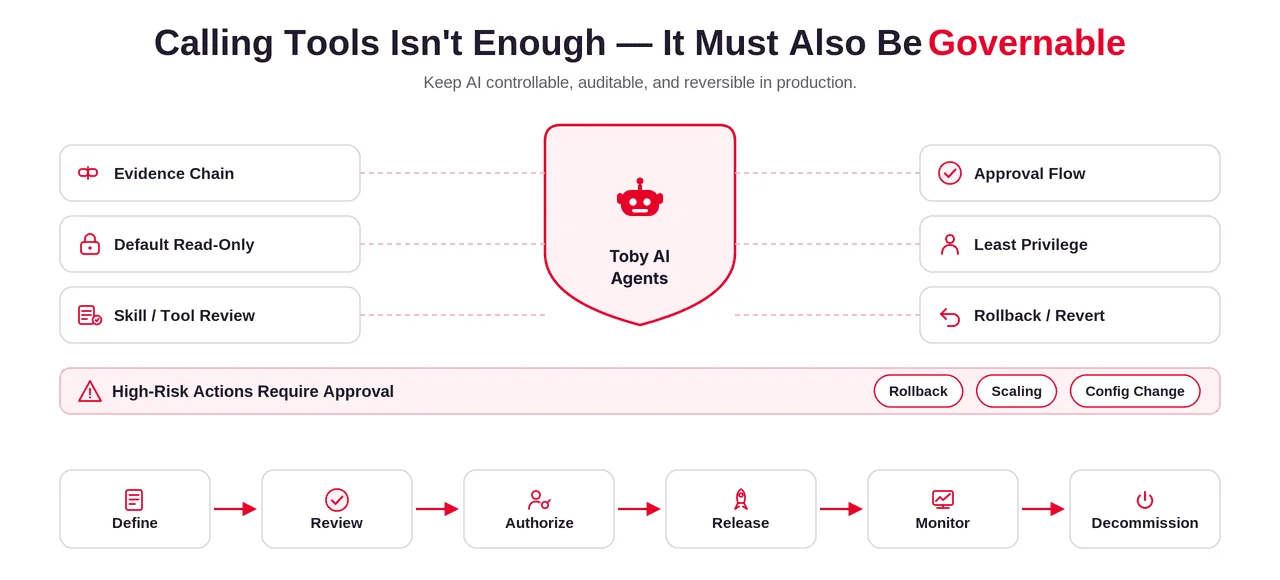
Production Agents Need Permission Boundaries by Default
If an agent silences a real alert, rolls back the wrong deployment, or redirects traffic incorrectly, the cost is measured in business loss, compliance exposure, and trust — not just a bad log line. That's why agent boundaries can't be an afterthought engineered per team; they need to be a default. This is what ai agent governance means in practice, not a slide in a security review.
Toby AI Agents treats this as a product capability, not a checklist:
- Evidence trail — every reasoning step, tool call, data sample, and decision is logged and reviewable after the fact.
- Approval flow — low-risk, reversible actions run automatically; anything with side effects (scaling, config changes, security response) escalates for human approval.
- Least privilege by default — read-only access to core systems unless a scoped, time-boxed exception is granted for a specific task.
- Tool lifecycle management — every skill and tool goes through definition, review, authorization, monitoring, and retirement, the same as any other piece of production infrastructure.
- Rollback and undo — actions that touch production are designed to be reversible, so a wrong call can be corrected rather than compounded.
The specifics of enterprise governance will keep evolving. The principle is already settled: a production AI agent needs a control plane, not just a list of tools it's allowed to call.
Agents Need a Shared Production Vocabulary
External agents don't automatically know what your services mean.
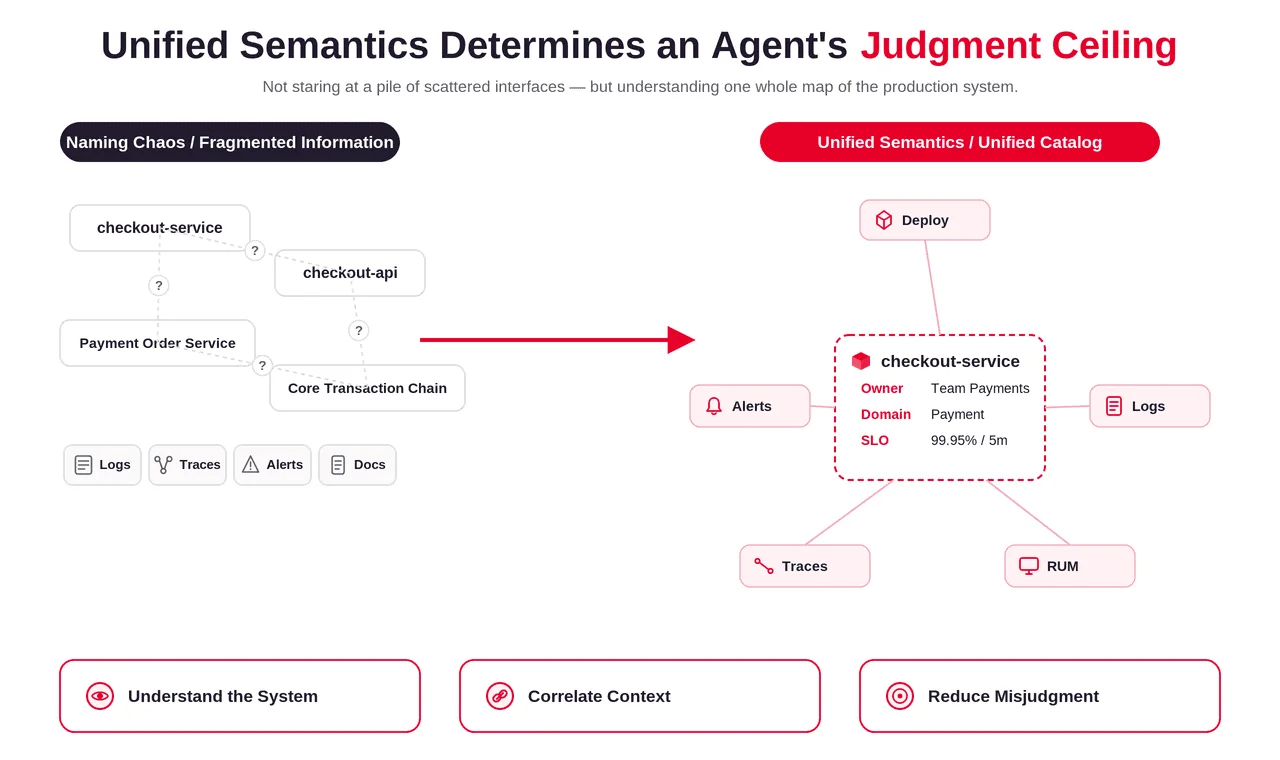
The same checkout-service can appear as checkout-api in traces, "payment order service" in alerts, and "core transaction flow" in a team doc. If an agent doesn't understand service ownership, topology, deployment history, alert semantics, and runbook context, it can misread the very data it's meant to reason over.
Toby AI Agents is built on unified TrueWatch semantics — a continuously updated view of the production system where services, dependencies, deployments, owners, alerts, logs, traces, RUM, events, and security signals connect into one operational context, not a pile of disconnected interfaces.
That shared context is what defines the ceiling of an agent's judgment. An agent reasoning over one unified map of the system will consistently outperform one stitching together fragments from five different tools.
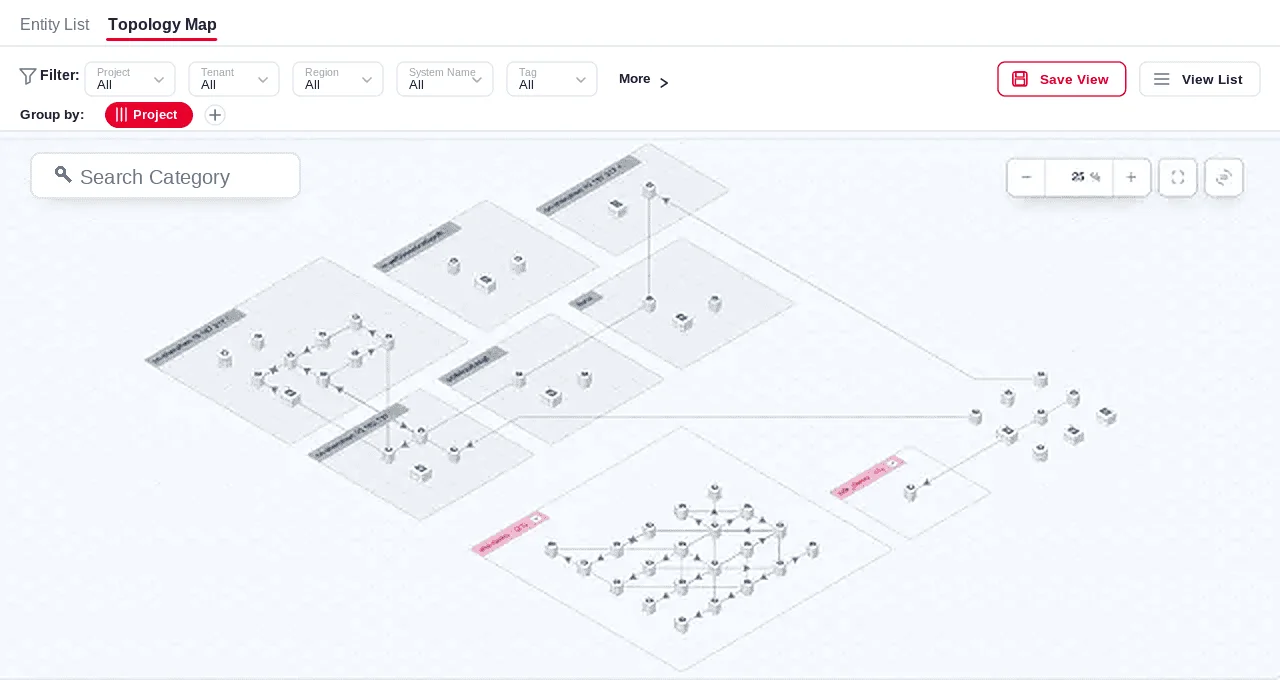
That shared context defines the ceiling of the agent's judgment. This is the practical meaning of ai agent observability here: not just data access, but data an agent can actually reason over.
Agents are Built to Run, Not Just to Build
Enterprises can build their own production agents. For teams with the engineering capacity, that's a viable path — but it's a real one: choosing models, designing agent roles, wiring permissions, building audit trails, orchestrating tools, debugging agent behavior, maintaining runbooks, training users, and keeping all of it current as the platform evolves. It becomes an ongoing engineering project, not a one-time setup.
Toby AI Agents productizes that work. With Toby AI Agents your team gets:
- Defined roles — an SRE agent focused on reliability and incident handling, a security agent focused on risk detection, a FinOps agent focused on cost, a QA agent focused on release quality — each scoped to its own permissions and knowledge.
- Production context out of the box — reasoning across services, dependencies, deployments, owners, alert policies, and historical incidents, instead of an isolated log line.
- A working tool layer — querying DQL, inspecting metrics, analyzing logs, correlating traces, checking changes, generating reports, and triggering workflows through CLI and MCP Server.
- Governance as a default, not an add-on — read-only defaults, approval flows, audit trails, and rollback design built in from day one.
- Continuity across shift changes — context that survives engineer turnover, lost context, and cross-system investigation under pressure.
- Works alongside your AiOps platform — Toby AI Agents plugs into the AiOps platform and IT ops tooling you already run, adding governed agent execution on top of existing alerting and correlation workflows instead of replacing them.
Mature platform teams that want to build their own agent architecture can still connect it directly to TrueWatch through MCP Server, CLI, and OpenAPI. For teams that want governed, production-ready results sooner, Toby AI Agents is the faster path — bringing methodology, tools, context, and boundaries together in one product.
Frequently Asked Questions About Toby AI Agents
Q: What's the difference between an agent with tool access and Toby AI Agents?
A: Tool access lets an agent call an API. Toby AI Agents adds the incident methodology, permission boundaries, shared production vocabulary, and audit trail that make that access safe and useful in production, not just technically possible.
Q: Does Toby AI Agents act automatically, or only recommend actions?
A: Both modes are supported. Low-risk, reversible actions can run automatically within defined boundaries. Anything with side effects — scaling, configuration changes, security response — requires human approval before execution.
Q: Can Toby AI Agents connect to frameworks like Claude Code, Codex, or OpenClaw?
A: Yes. TrueWatch exposes CLI, MCP Server, and OpenAPI, so teams already running agents in these frameworks can connect them directly to TrueWatch data and governance.
Q: What happens if an agent makes a mistake in production?
A: Every reasoning step, tool call, and decision is logged as part of an auditable evidence trail. Actions that touch production are designed to be reversible, so a wrong decision can be rolled back rather than compounded.
Q: Should we build our own production agent, or subscribe to one?
A: Both paths are viable. Teams with the engineering capacity to design roles, permissions, and audit trails can build on TrueWatch's MCP Server and CLI directly. Teams that want a governed, production-ready agent sooner can subscribe to Toby AI Agents.
Q: Is Toby AI Agents built for ai incident response, not just an incident management dashboard?
A: Yes. Toby AI Agents executes ai incident response end-to-end — triage, hypothesis generation, evidence collection, action recommendation, and result verification — instead of only displaying an incident management dashboard for a human to interpret.
Q: Does Toby AI Agents replace our existing AIOps platform?
A: No. Toby AI Agents is designed to work alongside your existing AIOps platform and ITOps tooling, adding governed agent execution and an evidence trail on top of the alerting and correlation you already run, rather than replacing it.
Toby AI Agents is built to close the gap between an agent that can call a tool and one your team can actually trust in production. Join the Toby AI Agents waitlist → to be among the first teams testing governed, production-ready AI agents on TrueWatch.
