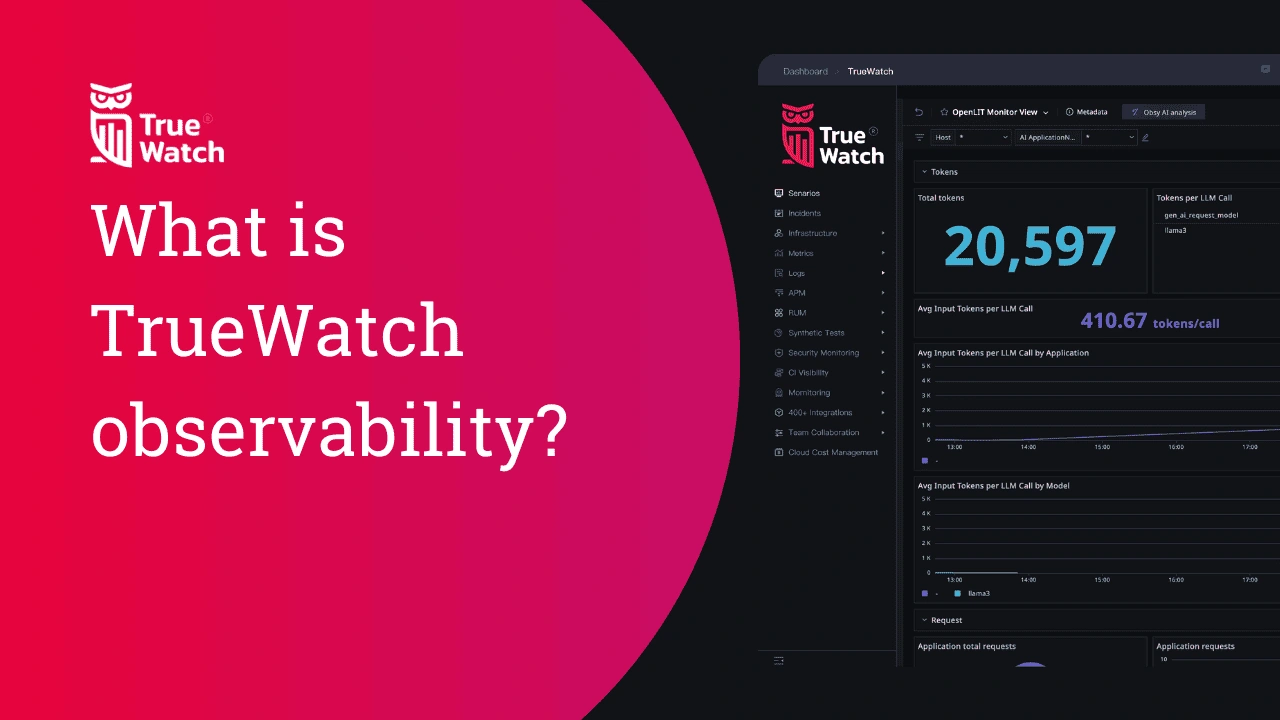
What is TrueWatch observability?
TrueWatch is a unified observability platform that consolidates metrics, logs, traces, and user experience data to provide real-time visibility into complex distributed systems. By correlating these signals in a single pane of glass, TrueWatch enables engineering teams to isolate root causes 50% faster than traditional siloed tools, ensuring high availability across multi-cloud and hybrid environments.
What is observability?
Monitoring helps you watch known health signals (for example, CPU, memory, error rate) and alerts you when thresholds are crossed. That is useful, but it often does not explain why an incident happened.
Observability helps you answer questions like:
- Which service is causing the slowdown?
- Is the issue coming from a dependency (database, cache, upstream API)?
- Did a deployment, configuration change, or traffic shift trigger it?
- Which users or journeys are affected?
In short, monitoring tells you something is wrong. Observability helps you understand what is happening and why.
What TrueWatch can do
TrueWatch supports full‑stack observability across infrastructure, applications, and user experience. Teams typically use TrueWatch to:
Full-Stack Observability
- Track metrics for health and performance trends
- Centralize and investigate logs for root‑cause evidence and audit trails
- Use APM tracing to see request paths, bottlenecks, and dependency impact
- Monitor real user experience (RUM) and validate availability with synthetic tests (where used)
- Build dashboards and alerts that point to clear actions
Enterprise Needs
- Multi‑cloud coverage across major providers (AWS, Azure, GCP, Tencent Cloud, Huawei Cloud, and Alibaba Cloud)
- Global nodes and regional endpoints so teams can operate closer to where users and data live
- Flexible deployment options, including regional SaaS and private deployment choices for customers who require it
TrueWatch eliminates observability gaps by consolidating infrastructure, application, and user experience data into a single pane of glass. It is purpose-built for global scale, supporting multi-cloud environments and regional data requirements while ensuring teams can resolve incidents faster and with greater confidence.
How TrueWatch works
TrueWatch supports a simple operating loop that most teams already follow during incidents:
- Collect the right signals Many teams start with the basics:
- Infrastructure and platform data (hosts, containers, networks)
- Application traces for critical services
- Logs from key systems (apps, gateways, databases, identity) TrueWatch makes this practical with a lightweight collection approach and broad integration coverage, so you can expand over time.
- Make the data usable Data only helps when it is searchable and consistent. For example:
- Logs should have clean timestamps, levels, and fields
- Services should follow consistent naming across environments
- Common labels (environment, service, region) should be applied consistently This is what turns “we collected data” into “we can find answers quickly”.
- Investigate and respond with context When something breaks, teams need fast pivots:
- Metrics show what changed and where impact is rising
- Traces show which requests and dependencies are slow or failing
- Logs provide detailed evidence
- Alerts and incident workflows help teams coordinate and respond consistently
- Built‑in AI and automation TrueWatch also includes tools that help teams move faster:
- Toby AI: a built‑in assistant that helps answer platform questions in natural language and can generate charts from your prompt.
- Automata (FaaS): a serverless function environment that gives teams flexibility to automate workflows and build custom integrations (for example, processing data, enriching signals, or connecting to internal systems).
Why TrueWatch?
Many observability platforms cover the basics. The difference shows up in real deployments, especially when you operate across clouds, regions, and teams.
Teams choose TrueWatch when they want:
- One platform for multiple signals
- Bring metrics, logs, traces, and user experience together, so investigations do not stall across disconnected tools.
- Multi‑cloud support without fragmentation
- Monitor and manage resources across six major clouds in a consistent way.
- Regional scale and deployment flexibility
- Operate with nodes in multiple regions and choose deployment options that fit governance and residency requirements.
- Predictable cost controls
- Observability only works long‑term when costs are visible and manageable. TrueWatch is designed for usage transparency and helps teams keep spending predictable as data volume grows.
- AI and automation that reduce manual work
- Use Toby AI for faster answers and charting, and Automata (FaaS) when you need workflow automation and custom extensions.
Frequenty asked questions (FAQs)
Q: How does TrueWatch differ from standard monitoring tools?
A: While monitoring simply alerts you that a system is "down," TrueWatch observability uses correlated data to explain why it happened. By linking metrics, logs, and traces, TrueWatch provides the context needed to find the specific service or deployment causing an issue.
Q: Can TrueWatch monitor applications running across different cloud providers?
A: Yes. TrueWatch is built for multi-cloud environments, supporting native integrations across six major providers including AWS, Azure, and Alibaba Cloud. This ensures you have a "single pane of glass" view even if your data is spread across different regions and vendors.
Q: What is the role of Toby AI in the TrueWatch platform?
A: Toby AI is a built-in assistant that helps teams investigate incidents using natural language instead of complex query code. It can instantly generate charts or answer platform questions, which helps engineers reduce the time spent on manual data analysis during a crisis.
Q: Does TrueWatch support custom automation for incident workflows?
A: Yes, through our Automata (FaaS) feature. This allows teams to run serverless functions that automate tasks like data enrichment or connecting signals to internal systems, giving you more flexibility than a standard out-of-the-box dashboard.
Q: How does TrueWatch help teams manage their observability spending?
A: TrueWatch provides high usage transparency and built-in cost controls to prevent "bill shock" as data volumes grow. This ensures that scaling your observability stays predictable and aligns with your actual infrastructure needs.
Next steps
Ready to see TrueWatch in action? Book a demo to see how our unified AI and multi-cloud automation can simplify your complex workloads and deployment strategy.
You can also explore our blog to go deeper into specific topics like APM, log management, RUM, synthetic monitoring, and cloud cost management.
