

Datadog vs New Relic vs Dynatrace comes down to three things: how each one charges, what you get for free, and where your data can live. Choose Datadog if you want a broad product catalogue and per-host pricing you can predict from your server count. Choose New Relic if you want one subscription with a 100 GB monthly free tier and are comfortable paying per user. Choose Dynatrace if you run a large estate, want heavy automation, and can commit to an annual platform spend.
All three are mature, full-stack observability platforms covering infrastructure, APM, logs and AI assistants. This APM tools comparison focuses on the points that change the bill and the contract, using list prices from each vendor's official pages, checked in October 2026.
Datadog vs New Relic vs Dynatrace at a glance
| Datadog | New Relic | Dynatrace | |
|---|---|---|---|
| Pricing model | Per product: per host for infrastructure and APM, per GB and per event for logs | Data ingested plus paid users | Annual platform commitment (Dynatrace Platform Subscription), drawn down at rate-card prices |
| Example list prices | Infrastructure Pro $15 per host per month (annual); APM $31 per host per month (annual, with Infrastructure) | $0.40 per GB ingested beyond 100 GB; full platform user $349 per month (Pro, annual) | Full-Stack Monitoring $58 per month per 8 GiB host; logs $0.20 per GiB ingested |
| Free option | Free infrastructure tier, up to 5 hosts | 100 GB of ingest per month, 1 full platform user, unlimited basic users | 15-day free trial |
| OpenTelemetry | Supported alongside the Datadog Agent | Native OTLP endpoint | Native OTLP ingest API |
| AI assistant | Bits AI | New Relic AI | Dynatrace Assist |
| Asia-Pacific regions | Japan (AP1), Australia (AP2) | Japan (through New Relic's Japan entity) | Sydney as standard; Singapore, Tokyo and Mumbai on request |
How Datadog, New Relic and Dynatrace pricing works
Each vendor uses a different pricing model, so the same workload can produce very different bills. Model your own host count, data volume and team size against all three before you compare totals.
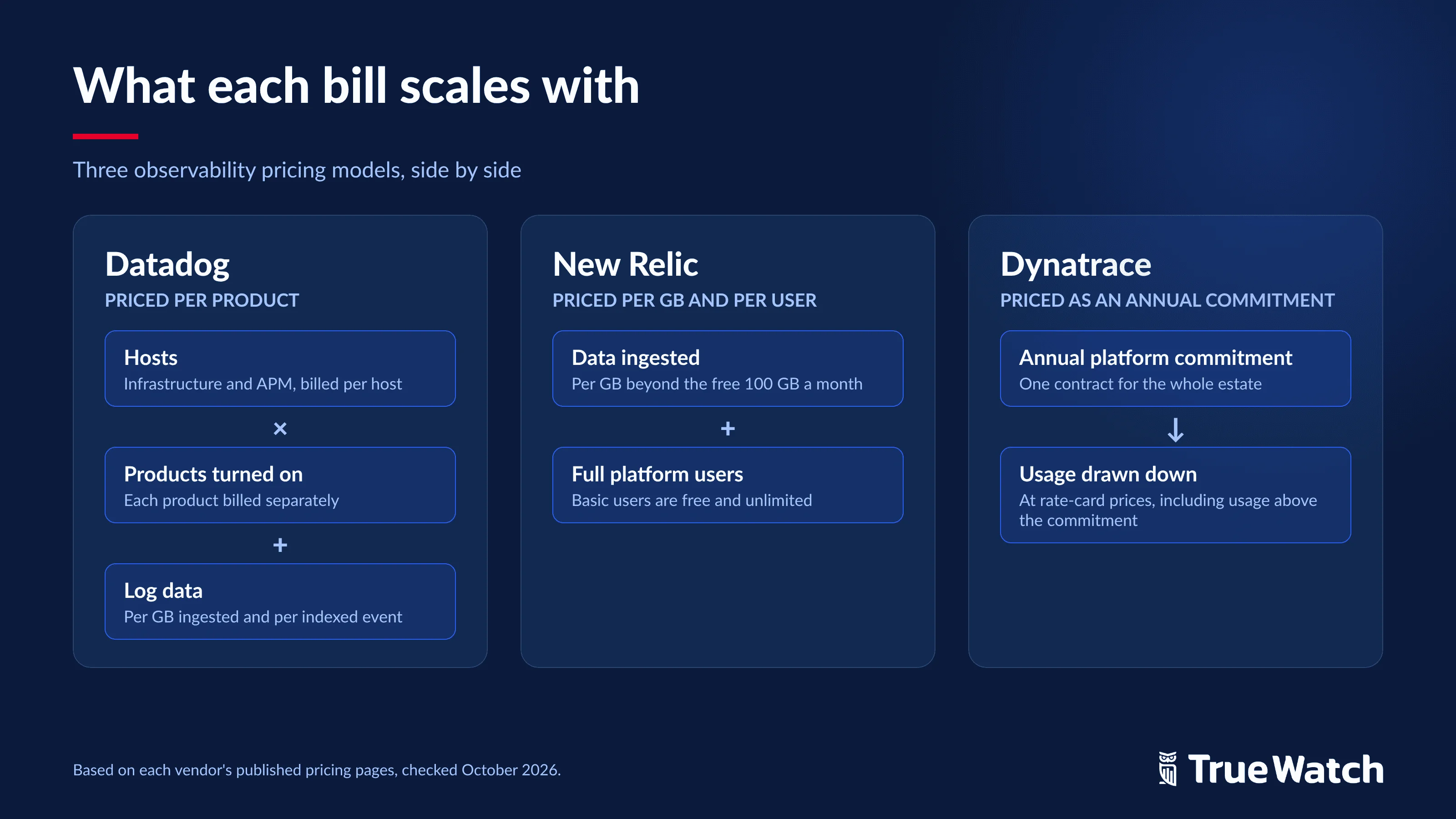
Datadog pricing: per product
Datadog sells each product separately. Infrastructure and APM are billed per host. Logs are billed per GB ingested ($0.10) plus per million indexed events ($1.70 for 15-day retention, annual). Your bill grows with the number of hosts and the number of products you turn on.
Works well when: you know your host count and want to add products one at a time.
New Relic pricing: per GB and per user
New Relic sells one platform. You pay for data ingested beyond the free 100 GB a month and for each full platform user. Basic users are free and unlimited.
Works well when: a small number of engineers need full access and many people only need dashboards.
Dynatrace pricing: an annual commitment
Dynatrace sells an annual commitment that you draw down against a rate card. Dynatrace states that usage above the commitment is billed at the same rate, not a penalty rate.
Works well when: you can forecast usage across the whole estate and want one contract for everything.
Free tiers and trials compared
- New Relic offers a permanent free tier: 100 GB of data a month, with no credit card.
- Datadog offers free infrastructure monitoring for up to 5 hosts.
- Dynatrace has no permanent free tier, only a 15-day trial.
Datadog vs Dynatrace
Datadog prices each product per host or per unit of data, so you can start small and add products over time. Dynatrace prices the whole platform through one annual commitment, which suits large enterprises that can forecast usage and want automation across the estate. For teams in Southeast Asia, Dynatrace lists Singapore as a region on request, while Datadog's Asia-Pacific sites are in Japan and Australia.
Datadog vs New Relic
The two scale on different things. Datadog's cost grows with hosts and products. New Relic's cost grows with GB ingested and the number of full platform users. Which one costs less depends on your mix of hosts, data volume and engineers, so run both against your own numbers.
New Relic vs Dynatrace
New Relic gives you a permanent free tier and usage-based billing per GB and per user. Dynatrace offers a 15-day trial and then an annual platform commitment. Both document native OTLP ingest, so OpenTelemetry instrumentation carries over to either one.
OpenTelemetry support and lock-in
All three accept OpenTelemetry data. New Relic and Dynatrace both document native OTLP ingest. Datadog supports OpenTelemetry alongside its own agent, which is still the default path for many of its features.
If avoiding lock-in matters, instrument with OpenTelemetry first. That keeps your options open whichever platform you choose.
AI assistants: Bits AI, New Relic AI and Dynatrace Assist
Each vendor now ships an AI assistant: Bits AI (Datadog), New Relic AI and Dynatrace Assist. All three answer questions about your telemetry in natural language. When you evaluate them, test them on your own incidents: ask each one to explain a real past outage and check whether the answer cites the right evidence.
Data residency in Asia-Pacific
This is where the three differ most for teams in Southeast Asia.
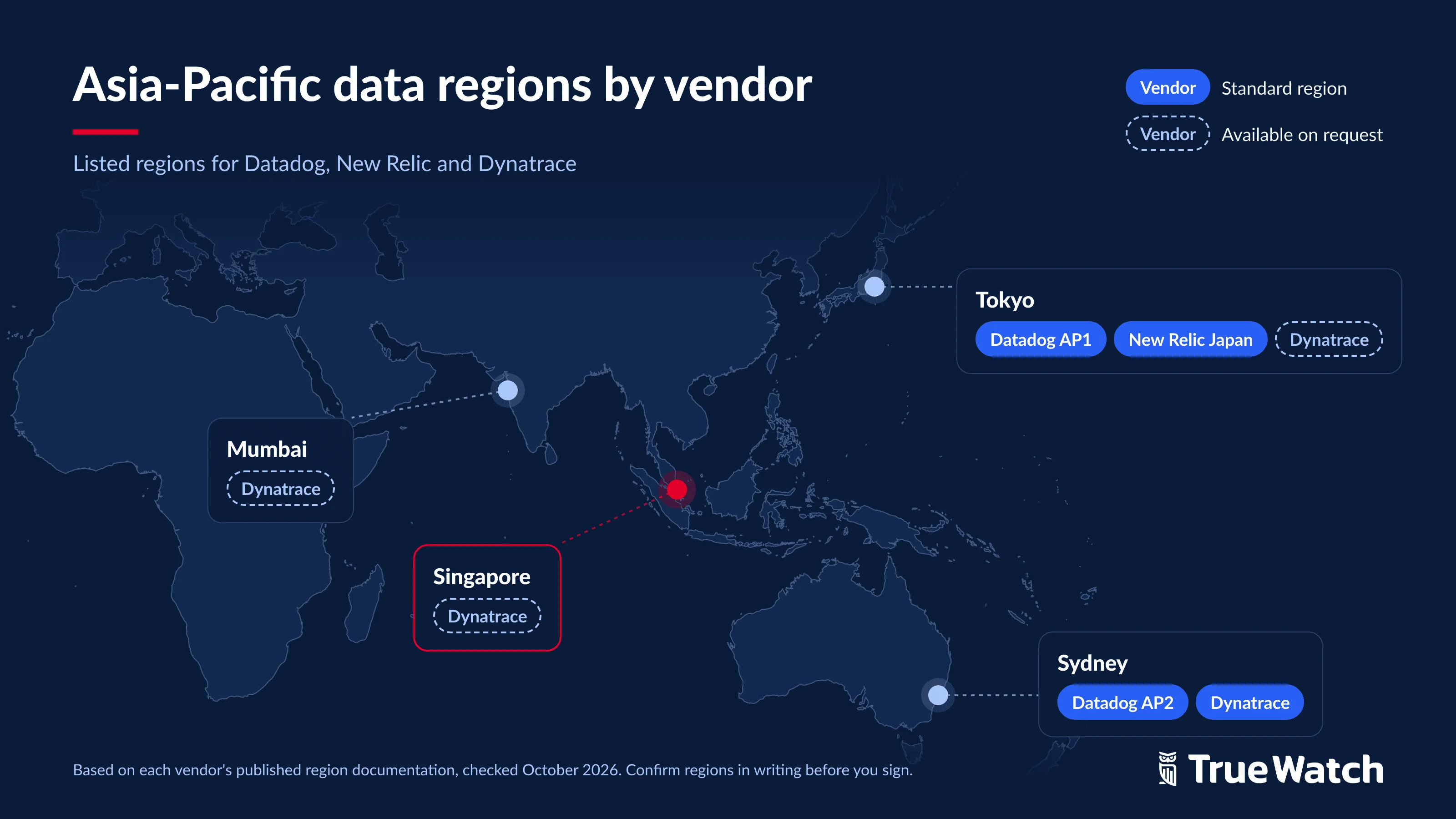
- Datadog: sites in Japan and Australia. No site in Southeast Asia.
- New Relic: US and EU regions, plus a Japan region offered through New Relic's Japan entity.
- Dynatrace: Sydney as a standard region. Singapore, Tokyo and Mumbai are available on request.
If your data must stay in Singapore or Indonesia, confirm the region in writing before you sign.
Which should you choose?
| If you... | Consider |
|---|---|
| Want a broad catalogue and add products over time | Datadog |
| Want a free tier and pay mainly for the engineers who need full access | New Relic |
| Run a large, complex estate and want one annual platform commitment | Dynatrace |
| Need data stored in Southeast Asia, or want AI agent observability in the same platform | See where TrueWatch fits below |
Where TrueWatch fits
TrueWatch is an observability platform built for the AI era. It bills by the data you actually send each day, with no per-host or per-user fee for standard monitoring, and it runs regional SaaS in Singapore and Jakarta. For a direct look at one vendor, read TrueWatch vs Datadog. For a wider list, read Best Datadog Alternatives & Competitors in 2026.
FAQ
Which is better, Datadog or Dynatrace?
Neither is better for everyone. Datadog suits teams that want to buy products one at a time and price by host. Dynatrace suits large enterprises that want automation across the whole estate and can commit to an annual spend.
Is Datadog better than New Relic?
It depends on your data volume and team size. New Relic's cost grows with GB ingested and full platform users. Datadog's cost grows with hosts and products. Model both against your own numbers.
Which is better, Dynatrace or New Relic?
New Relic suits teams that want a permanent free tier and usage-based billing. Dynatrace suits enterprises that prefer one annual commitment and broad automation. Both support native OTLP ingest.
Do Datadog, New Relic and Dynatrace support OpenTelemetry?
Yes. All three accept OpenTelemetry data. New Relic and Dynatrace document native OTLP ingest, and Datadog supports it alongside the Datadog Agent.
Which of the three has a data center in Singapore?
Dynatrace offers Singapore on request. Datadog and New Relic do not list a Singapore region.
Sources
Prices and regions checked in October 2026 on official pages: Datadog pricing, Datadog sites, New Relic pricing, New Relic data centers, Dynatrace pricing, Dynatrace data security controls.
