
Toby AI TruePilot: TrueWatch's AI Observability Assistant for Machine-Assisted Investigation
A single production issue today can touch Kubernetes, cloud resources, API gateways, backend services, databases, frontend sessions, logs, metrics, traces, and business events all at once. Cloud computing didn't just increase how much data enterprises generate — it multiplied how many places an engineer has to look before they understand what's actually happening.
More data isn't the problem. Making sense of it fast enough is. That's the gap Toby AI TruePilot, TrueWatch's AI observability assistant, is built to close — bringing AI directly into the daily workflows where engineers already spend their time: dashboard analysis, error analysis, intelligent alert grouping, and pipeline script generation. The goal isn't to remove engineers from the loop. It's to help teams read signals faster, form better hypotheses, and stop losing time bouncing between disconnected views.
What Is Toby AI TruePilot?
Toby AI TruePilot is TrueWatch's AI layer for observability — it connects your dashboards, logs, traces, alerts, and user behavior data with AI-assisted analysis, right where you're already working.
Rather than living in a separate chat window, Toby AI TruePilot stays close to the evidence: the dashboard you're viewing, the alert group you're triaging, the error you're investigating, or the Pipeline script you're writing. That proximity is what makes it useful — it's answering questions about the data in front of you, not a general-purpose assistant you have to feed context to first.
Toby AI TruePilot: Moving Observability From Manual Review to Machine-Assisted Investigation
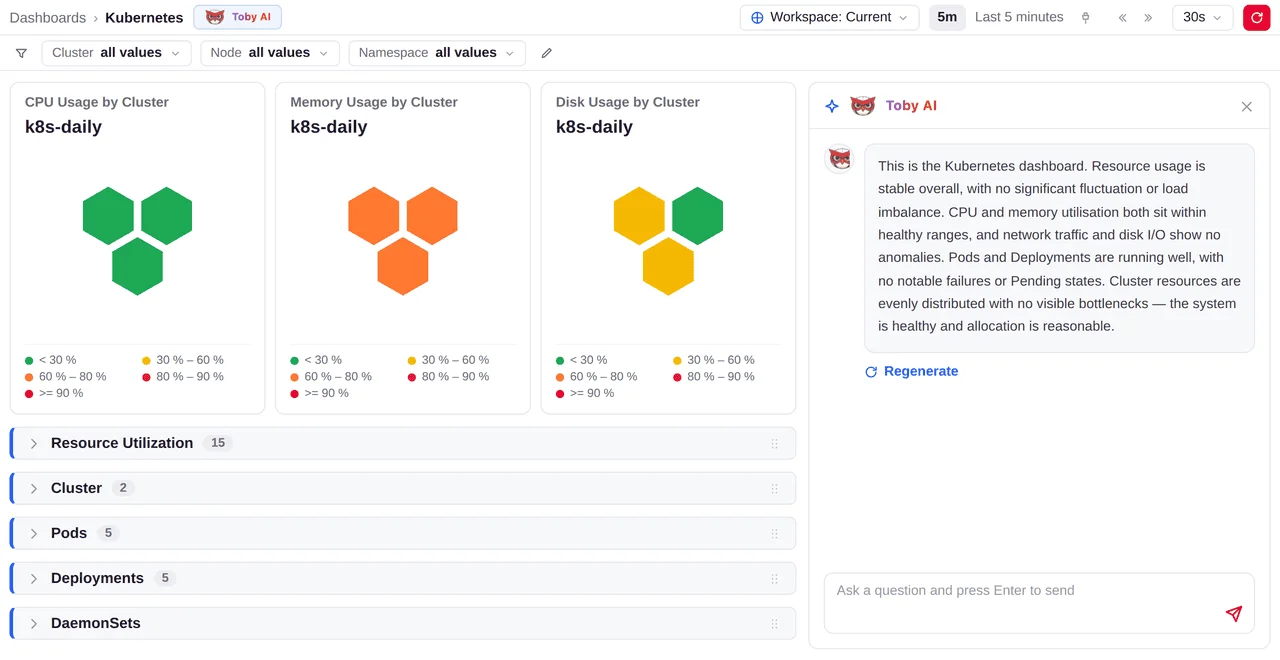
This doesn't replace a proper investigation — it gives your team a faster starting point.
How Does Toby AI TruePilot Speed Up Error Analysis?
Manual log review slows down fast once an error hits production. A real investigation needs more than one log line — related traces, affected services, recent changes, error patterns, and impact scope all have to come together. Toby AI TruePilot classifies and explains error information by working directly with logs and traces, cutting the time it takes to go from "an error happened" to "here's the likely area to inspect next."
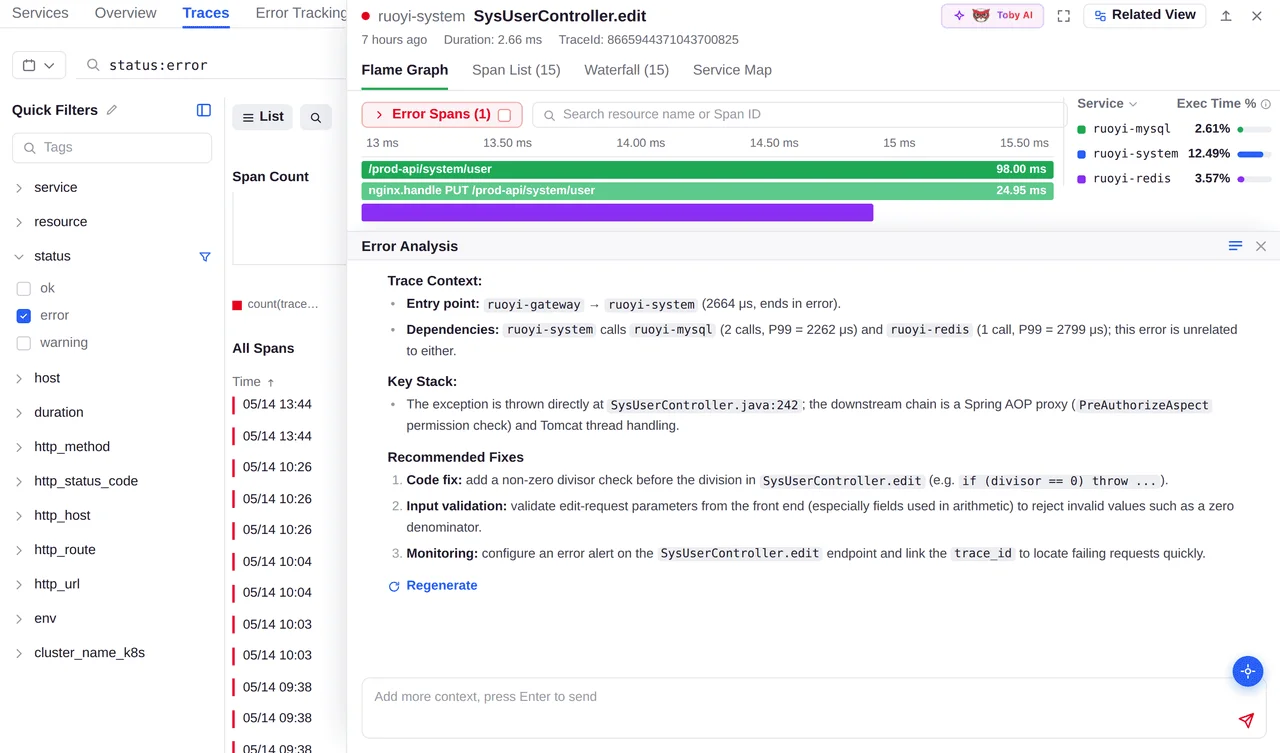
Treat the output as evidence-guided assistance, not a final verdict — engineers still confirm root cause against the full production context.
How Does Toby AI TruePilot's Intelligent Alert Grouping Reduce Noise Without Hiding Risk?
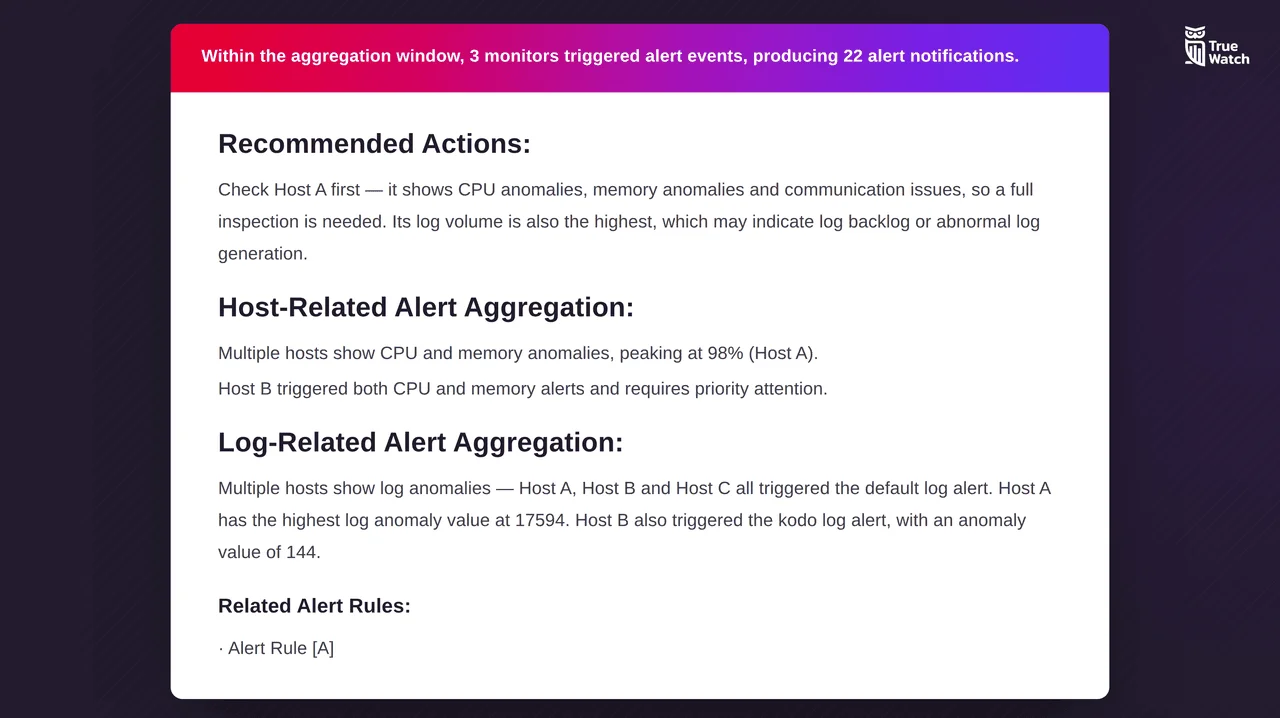
Alert noise is one of the most expensive problems in operations. When a single dependency fails, dozens of services can report related symptoms — and if every alert looks equally urgent, your team spends more time sorting duplicates than understanding the incident.
Toby AI TruePilot's intelligent alert grouping — a form of alert correlation — identifies similar and related alerts, so the alert stream is easier to read. The goal isn't to suppress signals — it's to cut repetition so your team can focus on the shape of the incident, which services are affected, and who likely owns the fix.
Can Toby AI TruePilot Generate Pipeline Scripts?
Processing observability data usually means writing Pipeline scripts — parsing logs, extracting fields, normalizing data, preparing events for downstream analysis.
Toby AI TruePilot generates a working first draft, so you're not starting from an empty editor. You should still review and test any generated script against real samples, but it removes the friction of writing that first version.
TrueWatch is also extending this into smaller day-to-day workflows — generating charts from natural language and suggesting chart names based on context. These aren't headline features on their own, but they remove the small points of friction that slow engineers down every day.
What Changes When Observability Becomes Machine-Assisted?
Traditional observability depends heavily on humans configuring views, checking dashboards, reading logs, and connecting signals under time pressure.
Machine-assisted observability changes that rhythm. AI reads the current context, groups similar signals, drafts queries or scripts, and points engineers toward the likely areas to investigate — while humans still make the judgment calls, especially anywhere an action touches production.
That's the direction TrueWatch is building toward: observability data that people can understand, AI can work with, and production teams can trust.
Frequently Asked Questions About Toby AI TruePilot
Q: What is Toby AI TruePilot? A: Toby AI TruePilot is TrueWatch's AI observability layer. It works inside your existing dashboards, logs, traces, and alerts to help you analyze data, investigate errors, group alerts, and generate Pipeline scripts — without switching to a separate tool.
Q: Does Toby AI TruePilot replace manual investigation? A: No. It gives engineers a faster starting point — surfacing likely causes and relevant context — but engineers still confirm root cause and make any production-impacting decisions.
Q: How does Toby AI TruePilot help during an incident? A: It analyzes dashboard changes, classifies error information across logs and traces, and groups related alerts so your team can focus on the actual shape of the incident instead of sorting through noise.
Q: Can Toby AI TruePilot write Pipeline scripts for me? A: Yes. It generates a first draft of a Pipeline script based on your data-processing needs — parsing, field extraction, normalization — which you then review and test against real samples.
Q: Is Toby AI TruePilot the same as Toby AI Agents? A: No. Toby AI TruePilot is the AI assistant built into your observability workflows — dashboards, alerts, errors, and scripts. Toby AI Agents is TrueWatch's autonomous agent product for production-ready, governed AI operations, including AI agent observability into what those agents do.
Toby AI TruePilot is built to sit inside the workflows your team already runs every day, turning manual review into machine-assisted investigation.
