TiDB Cloud Lake | TrueWatch
Retain years of observability data in TiDB Cloud Lake and query it back inside TrueWatch with native SQL.
Features
Keep every signal long enough to answer the question
Short retention windows answer short questions. The ones that decide budgets, like whether an incident is recurring, whether capacity growth is accelerating, or whether reliability actually improved this year, need a year of history, not thirty days of it. TrueWatch forwards logs, traces, metrics and events into TiDB Cloud Lake, where retention is a policy you set rather than a tier you buy.
With TrueWatch and TiDB Cloud Lake, teams can:
- Retain full-fidelity history — forward logs, traces, metrics and events into the lake instead of sampling them down to fit a retention tier.
- Set retention on your own terms — lifecycle, capacity and storage policies live in your TiDB Cloud Lake, under customer-managed governance.
- Analyze with native SQL — query years of observability data using the open standard SQL engine your data team already works in.
- Correlate with business data — join observability history against the orders, users and revenue tables already sitting in the lake.
Query the cloud lake without leaving TrueWatch
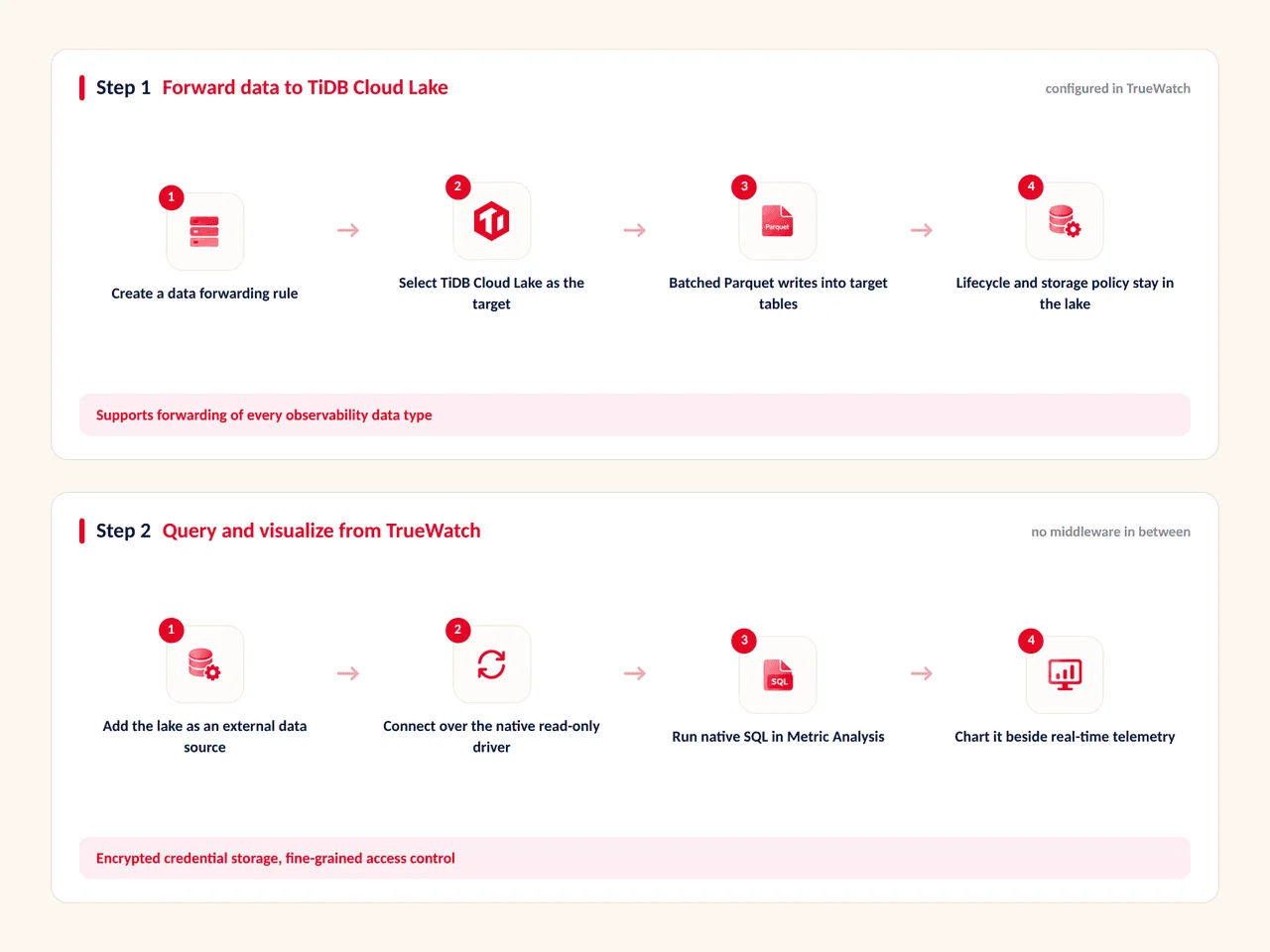
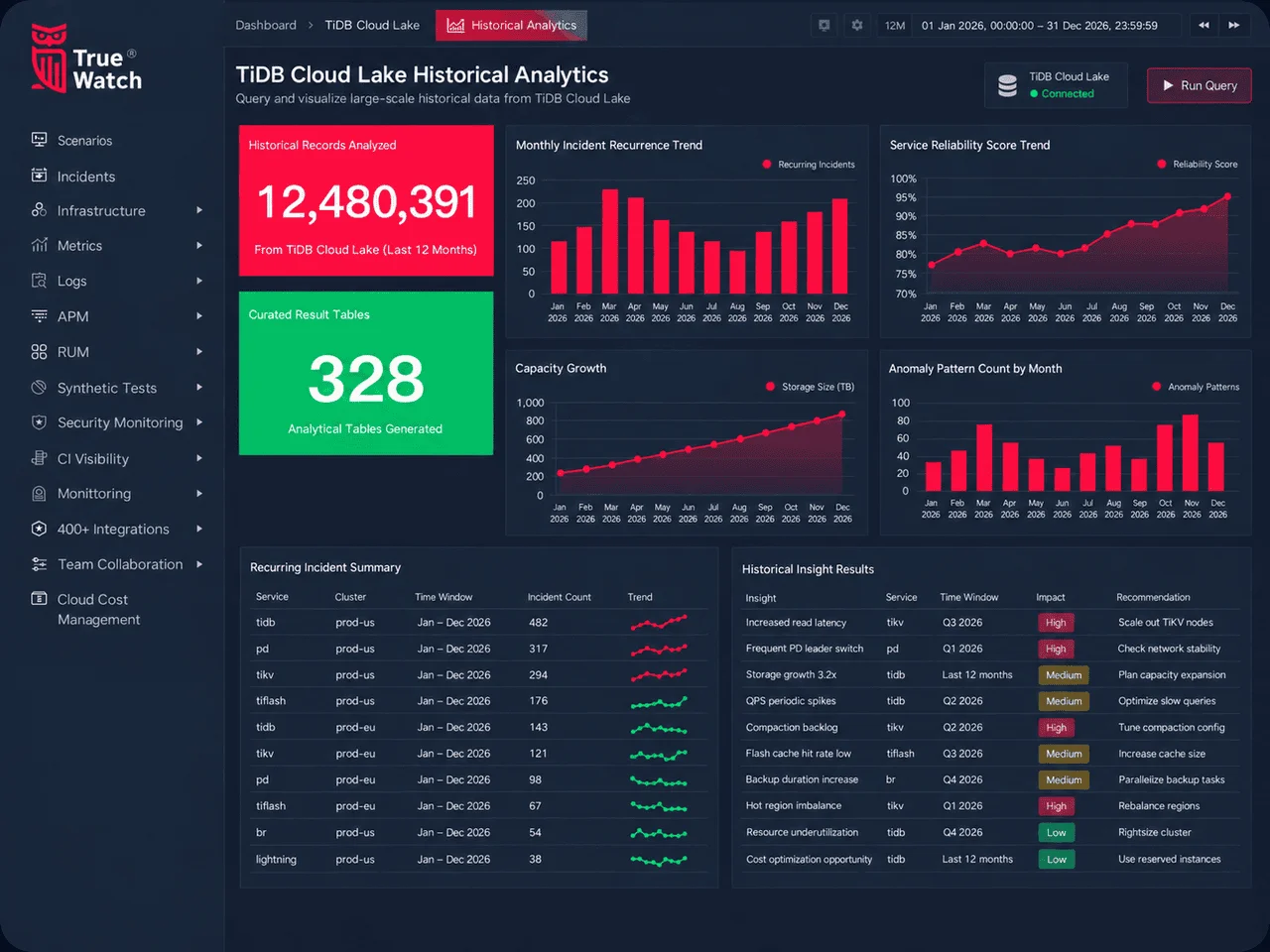
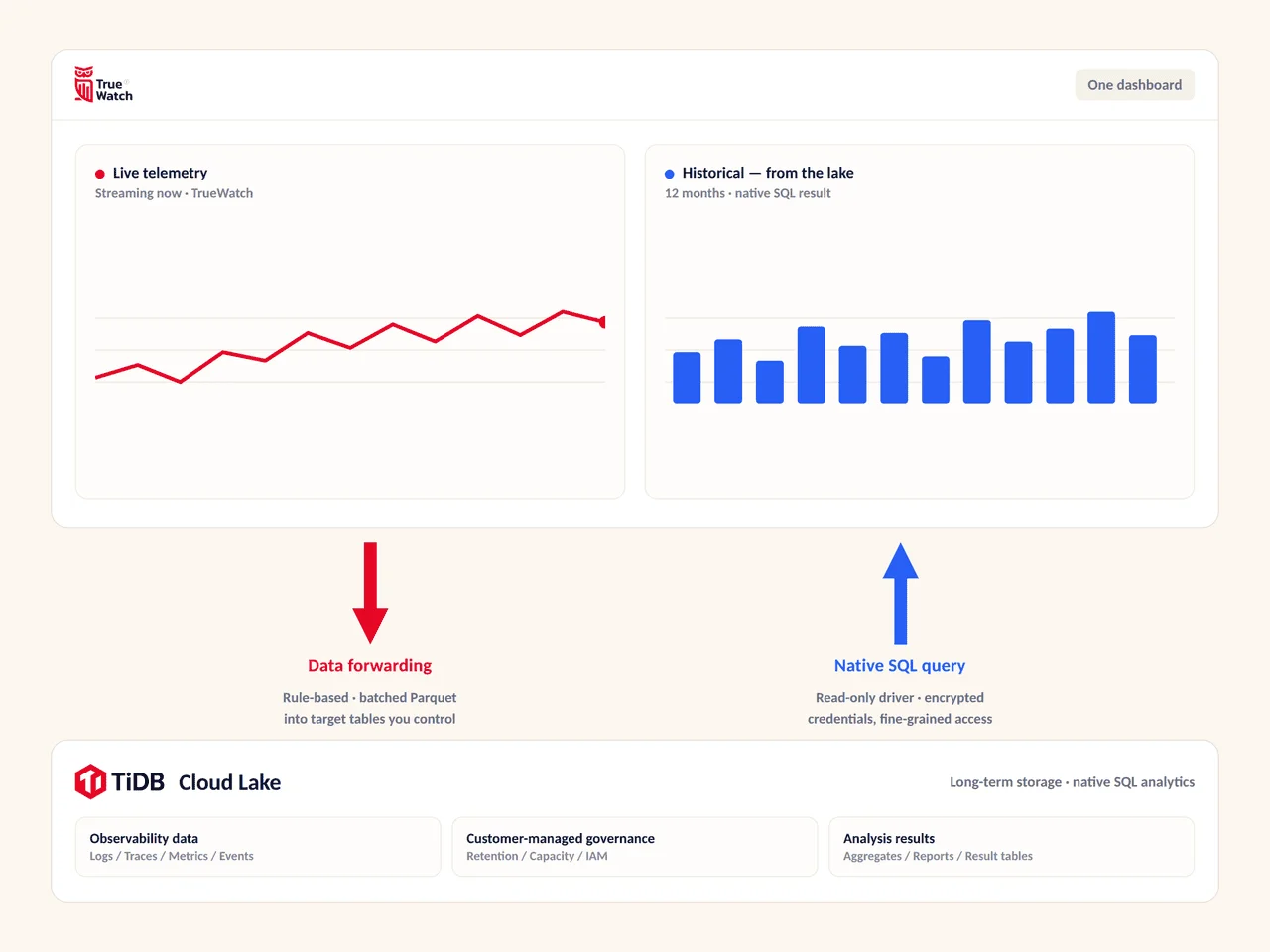
Forwarding data out of a platform is the easy part. The hard part is getting the answer back to where the on-call engineer is already looking. TrueWatch connects to TiDB Cloud Lake as an external data source over a native read-only driver, so historical results render on the same dashboard as live telemetry.
Together, they enable:
- Native SQL in Metric Analysis and Dashboards — write standard SQL against the lake and chart the result beside real-time signals.
- Read-only by design — encrypted credential storage and fine-grained access control; the query path cannot write back into the lake.
- One operational context — compare this morning's latency to the same week last year without exporting anything to a BI tool.
- No second console — SREs keep working in TrueWatch, and the lake stays invisible to everyone who doesn't need to see it.
Deploy in hours, not a data engineering quarter
There's no pipeline to build. Define what to forward, point it at TiDB Cloud Lake, and connect the query path back. No streaming cluster to run. No ETL jobs to maintain. No middleware to keep alive between the two platforms.
Simplify rollout and accelerate time to value with:
- Rule-based forwarding— choose which data types and filters go to the lake, and leave the rest in hot storage.
- Batched Parquet writes — data lands in open columnar format in target tables you control, readable by any engine.
- Direct external data source — add the lake once with a DSN and the native driver; nothing sits in between.
- Governance that survives audit — retention, capacity, IAM and lifecycle stay customer-managed end to end.